The Iran nuclear deal has largely divided congress along partisan lines. The current count in the Senate is 34 for and 32 opposed, according to the Bipartisan Policy Center. Of the 34 supporters, 32 are Democrats (2 are independent) and 30 of the 32 opponents are Republicans (2 are Democrats).
In the house, there are 16 Democrats opposed to the deal (out of 226) and three Republicans for it (out of 93). These figures show that in this particular case, Democrats are more likely to cross the aisle than Republicans despite the fact that 55 percent of Americans support the deal, according to a University of Maryland poll.
Nuclear experts, former American ambassadors to Israel, and former Israeli security chiefs are some of the groups that have thrown their support behind the nuclear deal. So why, despite the support of various experts and the American public, are more Democrats opposing the deal than Republicans?
Lobbying is one answer. “A lot has to do with fundraising. There’s no denying that,” Matt Duss, president of the Foundation for Middle East Peace, told ThinkProgress. “Very hawkish groups have proven to be very good and committed on foreign policy. There’s no comparable liberal or progressive or democratic oriented group that can give any comparable amount of campaign support on these issues. The intensity is pretty great on the conservative side.”
When the 34th Senator came out in support of the deal Wednesday, it meant that the opposition would not be able to sustain a potential veto of the deal.
Described by the White House as historic, the Iranian nuclear deal aims to prevent the building of a nuclear weapon. International sanctions will be removed to help the Iranian economy should Iran adhere to the agreement. A windfall of around $100 billion in frozen assets could then enter a struggling Iranian economy.
The deal stipulates that Iran cannot enrich uranium beyond 3.67 percent for at least 15 years and must dilute or sell already enriched uranium. A nuclear weapon can’t be developed without the uranium. Additionally, Iran must allow inspectors into all nuclear facilities — including military sites.
Analysts say that the overall negative perception of Iran and the simple talking points criticizing the deal have struck a nerve with voters.
“When you’re dealing with foreign policy — an issue on which voters tend to have not a lot of information — simple stories are much easier to understand,” Duss said. “The ‘Iran is evil and it’s horrible and they want to kill everyone’ [talking point] is much easier to understand than explaining a complicated deal that constrains the nuclear program.”
Discourse surrounding Iran’s role as a dangerous actor in the Middle East doesn’t differ much between supporters and opponents of the deal. The hostage crisis that followed the Iranian Revolution in 1979 has also left some Americans weary of trusting the current regime.
“Iran conjures all these negative things in the minds of Americans,” Brian Katulis, a senior fellow at the Center for American Progress, told ThinkProgress. “People see protests where they chant ‘death to America’ and reports show Americans opinions of Iran is pretty low — whereas the reverse is not true. The general perception of Americans in Iran are pretty positive.”
This is even more pertinent when discussing Israel — a country that also gets its share of malice from parts of the Iranian population even though that may not be how the whole country feels. “Israel is a big issue in American politics no getting around that,” said Duss. “The U.S.-Israel relationship is an important relationship for U.S. foreign policy for a whole range of reasons. Groups committed to Israel play a big part in American politics and of course that’s fine and appropriate.”
A number of Jewish-American lawmakers have taken hits for landing on either side of the deal. Those coming out against the agreement — like Sen. Chuck Schumer (D-NY) have been accused of having dual loyalties — an anti-Semitic trope.
“I’ve been accused of being treacherous, treasonous, even disloyal to the United States,” Rep. Nita M. Lowey (D-NY), an opponent of the deal, told the New York Times.
Meanwhile those in support have been criticized heavily and accused of claims like promoting fratricide.
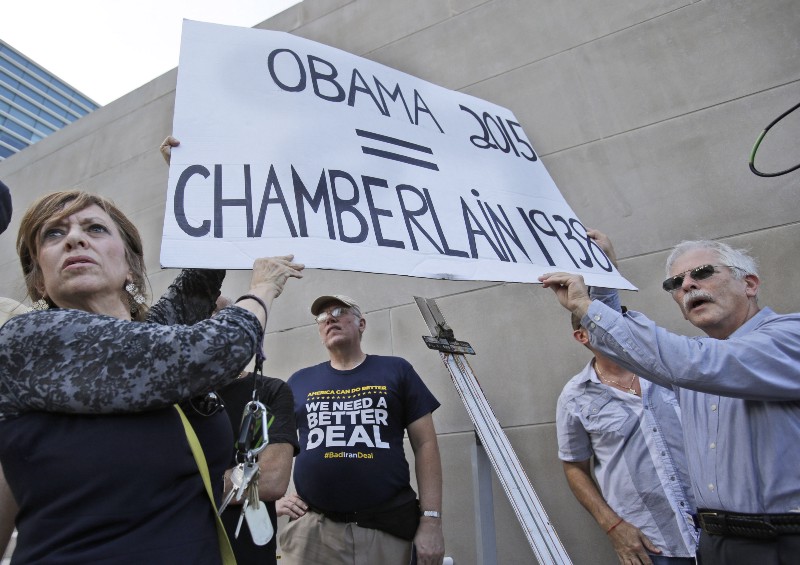
Some supporters of the deal say voting against it is akin to voting for war. Opponents say abiding by the deal will simply embolden Iran and make the world a more dangerous place. Some have even invoked the memory of the 1972 Munich Massacre or liken the deal to Neville Chamberlain’s concessions to Nazi Germany.
Katulis said he felt a lot of the politicized threats around the deal were oversimplified
“Rhetoric has cheapened dialogue,” he said.
“People’s perceptions over what the deal does and doesn’t do, fundraisers, and donors are all factors [on how Congress votes],” said Duss. “It’s hard to know how much one or the other plays in to a Congress member’s decision.”