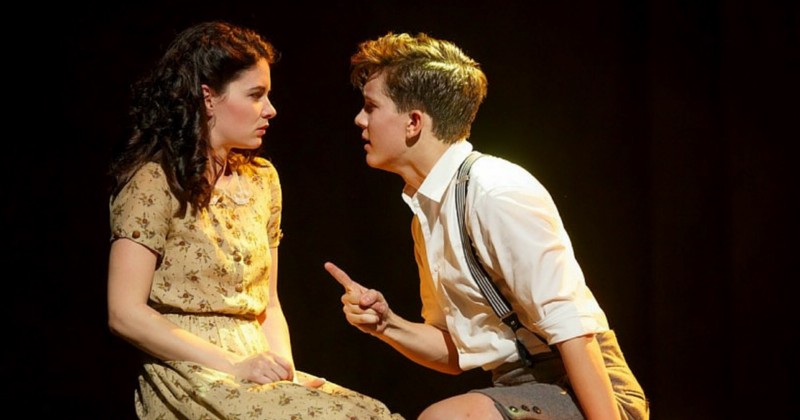
Deaf West Theatre’s Spring Awakening has been nominated for three Tony Awards. The cast has also been invited to perform at the ceremony, which will air live on CBS on Sunday, June 12.
There’s just one problem: They can’t afford to go.
“Our show closed in January, so we do not have a marketing budget to spend on this performance,” David J. Kurs, Deaf West’s artistic director, wrote to ThinkProgress. (Kurs is deaf, so we conducted our interview through email.) “The cost involves all of the little things that go into a performance: our cast is all over the nation, and we have to fly them in, for example. There are performance fees to pay out, we have to get our costumes and props out of storage, and so forth. The little things add up.”
The little things add up to $200,000, which Deaf West is trying to raise on Kickstarter. At press time, Deaf West was about 25 percent of the way toward that goal, with 17 days left to go in fundraising.
According to Kurs, the American Theatre Wing, which produces the Tony Awards, does not offer funds to the shows that perform. Kurs recalled that when Deaf West’s production of Big River was nominated in 2003, “We wanted to do a live production” but didn’t have the money. “The show played a highlight reel of the production instead.”
A representative from the Tony Awards had no comment.
Deaf West is using Kickstarter in part because “it had the best brand recognition” and in part because of the “nice synchronicity about it: We began this production by raising funds on Kickstarter for our small 99-seat production of this show two years ago.” Deaf West’s Spring Awakening played a sold-out engagement at Rosenthal Theatre in Los Angeles in fall 2014, then opened in New York last September at the Brooks Atkinson Theatre, where it concluded its critically-acclaimed run on January 9. (Read our review of the Broadway production here.)
How Deaf West’s ‘Spring Awakening’ Gets At The Heart Of The Show: Everyone Wants To Be HeardIt is hard to put into words what is so extraordinary about the Deaf West Theatre Company’s Spring Awakening. Which is…thinkprogress.orgWhen the show opened in New York, Kurs said, “We met so many people who had never seen sign language or a deaf person for that matter. I wish that more people understood the richness and depth of our language and culture, and that deaf people have so much to offer the world. Only language separates the two worlds.”
Kurs claims that he was “caught off guard when the nominations were announced” and, as a result, unprepared for this financial conundrum. “I was under the impression that our chances of recognition were diminished because we had closed our limited engagement in January. I was even more thrilled, however, at the offer of a performance slot. I prefer to show the magic that we do than, say, to explain it in words.”
There has been a considerable amount of conversation about the way Hamilton has radically altered audiences’ expectations about what a Broadway show can be and, more importantly, who can be in one, and rightfully so. But Deaf West’s Spring Awakening does that, too, upending whatever preconceived notions a theatergoer might have about whether or not a person who is deaf or hard of hearing can perform in a musical. The show also features Ali Stroker, the first actor in a wheelchair to perform on Broadway.
When director Michael Arden spoke with ThinkProgress last October, he described the real historical context in which the revival would be grounded: The Milan conference, an international meeting at which deaf educators decided that oralism was the only acceptable course of study, thereby forcing deaf children to learn to read lips and speak and banning them from using sign language. In Deaf West’s Spring Awakening, then, the teenagers in the story are denied the ability to speak and be heard in the most literal, profound way.
“You think about how our greatest strength is language, our ability to communicate,” Arden said. “To deny any group of people that is a form of genocide. That’s just been an incredible lesson to have learned, and an incredible warning to us. The play at its core serves as a warning for what can go wrong when you withhold information or when you deny people a voice.”
Cast member Daniel N. Durant played Moritz, who is deaf. His character is forbidden from signing in class and goes home each night to a father who screams in his ear, as if he can force his son to hear him. “The Deaf community is a marginalized, and often oppressed and misunderstood community,” Durant wrote to ThinkProgress by email. “Any opportunity we have to showcase ASL and Deaf Talent on a national platform is one that can impact change in ideology. Each opportunity for exposure at this level serves to build bridges between the Deaf and hearing communities. Bridges serve to bring people together. That is the end goal here. To come together to impact change.”
“There are very few chances for our language and culture to be displayed on a nationwide scale, and we want to show the world what we do,” said Kurs. “I am of the belief that art is the best way to change minds and hearts. We have a rich language and culture, and it has been hidden from the world for far too long.”
“Sign language does not make its way to Broadway often, or even to the Tonys,” Kurs went on. He believes the last time someone signed at the Tony Awards was 35 years ago, when Phyllis Frelich won a Tony for Children of a Lesser God. “We have a chance to change this, and it’s too good to pass up. We have to rely on the goodwill and generosity of our fans for this opportunity. They understand this, too. The moment feels bigger than our show.”