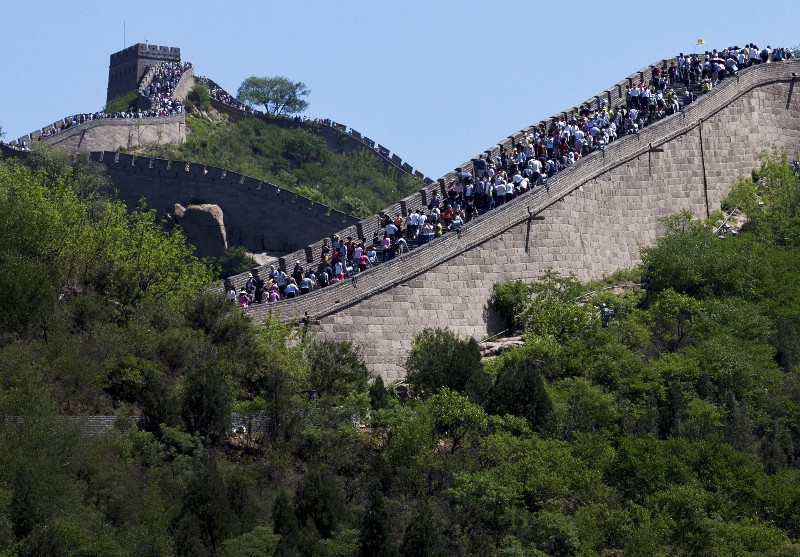
The Great Wall of China stretches anywhere from 13,000 to 5,600 miles. The huge variance between those estimates is based on the current state of the Great Wall — some parts have become so dilapidated that they’re scarcely considered part of the structure any longer.
According to a report by the State Administration of Cultural Heritage, about one-third of the man-made portion of the wall has vanished entirely due to both natural and human causes. More of the Great Wall is likely to have disappeared since that report was issued in 2012. Experts cited in various Chinese newspapers have leveled alarm at the deteriorating state of one of the world’s most iconic heritage sites.
“Even though some of the walls are built of bricks and stones, they cannot withstand the perennial exposure to wind and rain,” Dong Yaohui of the Great Wall of China Society told The Beijing Times, which ran a story on the Wall’s current state on Sunday.
“Many towers are becoming increasingly shaky and may collapse in a single rain storm in summer,” he said.
Another major factor contributing to the Great Wall’s deterioration is due to human factors.
“Residents who live along the Great Wall used to pull down bricks to build houses and some sections of the Great Wall were destroyed during urban expansion or the building of roads,” Cheng Dalin, a Great Wall expert with the Chinese Association of Cultural Relics told the Chinese newspaper Global Times Sunday.
Many of the bricks are engraved with Chinese words, and are considered by scholars to be invaluable historic relics. And yet, according to The Beijing Times, bricks from the Great Wall can be found on sale in nearby village markets for as little as $7 or $8 dollars.
Heavy foot traffic and adventurous tourists climbing up and down the Great Wall has also caused it to crumble in some parts.
While China adopted a set of regulations to protect the Great Wall from such damage in 2006, the Beijing Times noted that since such few resources devoted to policing those restrictions, they amount to, what it called, “a mere scrap of paper.”
“Surveys about the state of the Great Wall built in the Ming Dynasty (1368–1644) showed that there are few problems to protect the Great Wall in theory. But in reality, it requires local authorities to strengthen enforcement of related laws and regulations,” said Cheng Dalin, the Great Wall expert.
Although the Beijing Times article that spurred attention towards the Great Wall was largely based on a government report from 2012, it’s brought the issue into the public eye. Many in China have raised an outcry about the deterioration of the UNESCO world heritage site on social media.