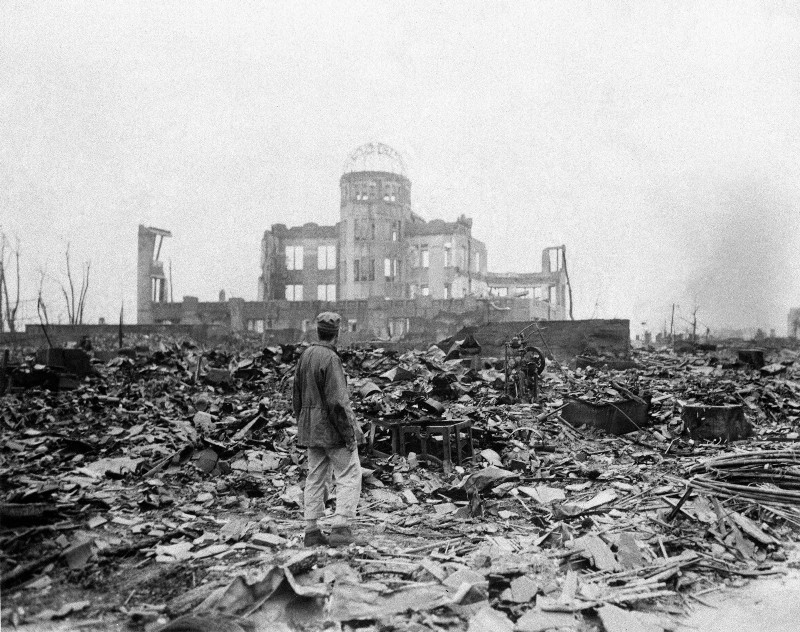
For the past seven decades, Hiroshima, one of two Japanese cities deeply scarred by nuclear annihilation, has prevented the United States and Japan from reaching a final reconciliation. The U.S. has never offered an apology for the bombings, which killed about 140,000 people.
Now, President Barack Obama will become the first sitting U.S. president to visit Hiroshoma, aiming to “highlight his continued commitment to pursuing the peace and security of a world without nuclear weapons,” according to a White House statement released this week. Obama will visit the city later in May and conclude his tour at the Hiroshima Peace Memorial Park — near the spot where the Enola Gay, a United States warplane, dropped an atomic bomb in 1945.
Obama’s visit will not include an official apology. Still, Japanese Americans are welcoming the symbolic measure, hoping that his visit will spark a commitment to peace and to better relations between the U.S. and Japan.
Rep. Mike Honda (D-CA) — whose late wife survived the attack in Hiroshima as a baby — applauded Obama’s visit as “monumental” in a press statement on Wednesday.
“No family, no child, should ever face a nuclear attack again,” Honda said. “I hope the President’s visit will remind us of the dangers of nuclear proliferation in our world today.”
To not have a sitting president visit Hiroshima has been the elephant in the room.
Doug Erber, the president of the Japan America Society of Southern California, called Obama’s visit a “good thing” because it could serve as a reminder for there not to be “a repeat” of the atomic era. Erber is not of Japanese lineage but he was spurred to take on the role at his organization because of his best friend who is Japanese.
Dr. Satsuki Ina, a psychotherapist specializing in trauma treatment for Japanese Americans, echoed those sentiments. She told ThinkProgress that Obama’s visit to Hiroshima is a “great first step” that could help people see the “atrocity” of war.
“I’m glad he’s visiting Hiroshima,” Ina said in a phone interview. “To not have a sitting president visit Hiroshima has been the elephant in the room. It was a horrible effect of two countries going to war so the acknowledgment of that is very important.”
But Obama’s visit isn’t only about reflecting on the past. In an election year marred by proposals to bar Muslims from entering the country and deport 11.3 million undocumented immigrants, it could also encourage people within the United States to remember what the government once did to its own citizens of Japanese heritage.
Between 1942 and 1946, the U.S. government locked up more than 120,000 U.S. citizens of Japanese lineage in internment camps across the United States.
Honda, for instance, was incarcerated for three years at a camp in Colorado when he was just a toddler. And Ina was born at a camp in California, where she and her family were imprisoned after her parents answered “no” to a loyalty questionnaire issued by the U.S. government to distinguish whether they were “loyal” or “disloyal.” In answering “no,” Ina’s parents renounced their American citizenship out of hopes of being able to go back to Japan where they were partly educated.
Although they are typically described as internment camps, Ina has called on the media to change the language used to describe the facilities that imprisoned Japanese Americans.
“Japanese Americans were Americans placed in prison camps,” she said. “These prison camps qualify as concentration camps. You can call them prison camps, incarceration camps, but when people use the word internment, it gives it a legitimacy that really isn’t appropriate.”
Dr. Shirley Higuchi, the chair of the Heart Mountain Foundation, an organization dedicated to educating the public about the imprisonment of Japanese Americans during World War II, told ThinkProgress that it’s important to share the stories of these prison camps in order to help preserve the rights of the American citizens who are being targeted today.
Higuchi’s parents were incarcerated at a camp in Wyoming. She said they didn’t tell her much about what happened to them when they were in the prison camps — but as part of the nisei, or second generation, it’s up to people like her to make that history known.
If we don’t learn from this experience, unfortunately, it could happen again.
“If we don’t learn from this experience, unfortunately, it could happen again,” she said. “We see it happen with Muslim Americans, Arab Americans, facing racial profiling and other discriminatory issues that could result in similar circumstances.”
In the years since World War II ended, Japan and the United States have come very far in building a deep alliance “based on mutual interests, shared values, and an enduring spirit of friendship between our peoples,” Ben Rhodes, Obama’s deputy national security adviser, wrote in a Medium blog post. Rhodes emphasized that Obama “will not revisit the decision to use the atomic bomb at the end of World War II” and will instead take a forward-looking approach to the shared goals between the two countries.
Still, Japanese Americans ultimately want an apology.
“I think what happened to the Japanese people was an atrocity and that there should be an apology for all the innocent people who were killed,” Ina said. “This was not on a battlefield. This was in a city.”
“I don’t know all the ramifications of what an apology would mean,” she added. “But I would certainly feel like from a human point of view, to acknowledge and apologize for an act of war that was in my mind unnecessarily cruel to innocent victims, would be appropriate.”