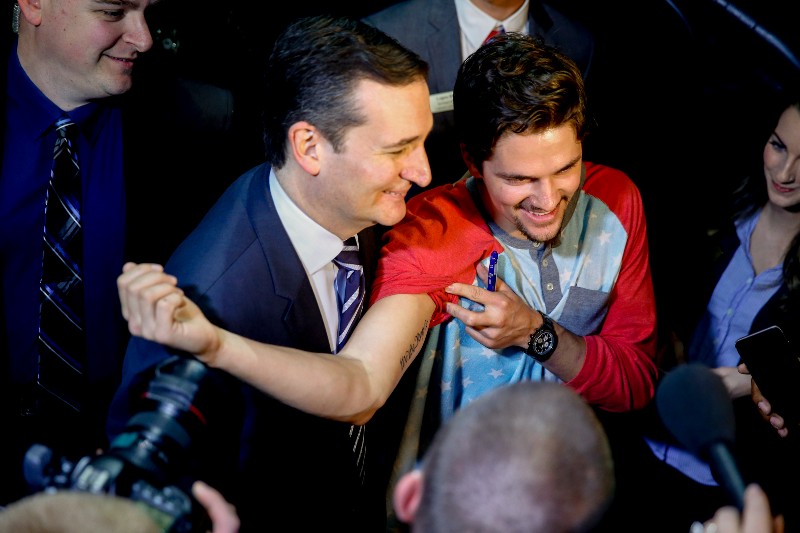
Less than a week before officially announcing his candidacy for president on Monday, Texas Sen. Ted Cruz (R) celebrated St. Patrick’s Day in a small dive bar in Arlington, VA. The freshman Senator ended his day on stage in front of a crowd of close to 100 young Republicans who had already taken full advantage of the free green beer flowing from the bar.
“What I want to do is talk to the young people and tonight, St. Patrick’s Day, we’re all young people at heart,” the 44-year-old senator said at the event hosted by the Disruptor Fund, a Virginia political action committee geared toward young conservatives. “If you were to sit down to try to design an agenda to hammer the living daylights out of young people, you could not come up with a more effective agenda than the Obama economic agenda.”
The green beer was one of Cruz’s recent attempts to reach out to younger audiences as he becomes the first official candidate to launch his 2016 presidential campaign. He chose Liberty University as the location for his presidential announcement Monday and already has a young professionals event in New York City on his schedule for this week. On St. Patrick’s Day, he told the audience the youth vote will be essential to whoever wins the Republican nomination.
From the small dive bar stage, Cruz joked about a meme he created to explain the “failures of Obamanomics” that have led young people to sleep in their parents’ garages (young people under Reagonomics started companies in their parents’ garages, he said). He also had the audience laughing when he talked about his response on Twitter to the photoshopped posters of his muscular, tattoo-covered body that appeared around Los Angeles last year.
But Cruz will have to do more than show his understanding of internet trends to win support of millennials. The presidential field is likely to be packed with conservatives who can more easily rally support of young people, like Sen. Rand Paul (R-KY) who has been working improve the party’s image among young voters. Affinity for the Democratic Party among young people has also been growing over the last decade as the population becomes more racially diverse and more liberal. According to a 2013 poll, 53 percent of people aged 18 to 29 identified as Democrats while only 35 said they were Republicans.
Given demographic trends and the growing number of young voters — younger voters accounted for a 19 percent of the 2012 electorate — Republicans will be desperate to court the youth vote in 2016. But the policies Cruz has supported aren’t likely to appeal to the voting bloc he needs in order to secure the White House.
In nearly every speech he gives, Cruz says he wants to “repeal every word of Obamacare,” which would include the provision that allows people under 26 years old to stay on their parents health insurance. Not only are Cruz’s young audiences likely taking advantage of that feature of the Affordable Care Act — three million young Americans have healthcare coverage through their parents this year because of that provision — but the law also continues to draw more support from young adults than older people. Among people under 30, more approve (55 percent) than disapprove (41 percent) of the law, a recent poll found.
Cruz’s staunch opposition to Obama’s executive action on immigration isn’t likely to win over too many millennials either. Cruz has demanded that any immigration plan also include increased border security. But a poll last year found that both young people and Hispanics give greater priority to finding a path to citizenship for undocumented immigrations than to securing the border.
In his announcement Monday morning, Cruz told the college students at Liberty University to “imagine a federal government that works to defend the sanctity of human life and uphold the sacrament of marriage.” But young people are far more likely to support legalizing abortion under any circumstances than their older counterparts and 69 percent of people ages 18–29 — including 61 percent of Republicans in that age range — favor allowing gays and lesbians to marry.
A 2014 poll found that young voters are much more likely than older voters to consider the environment when casting their ballots, with 64 percent of 18–29 year old voters saying it’s an important issue to them. But Cruz has been a staunch climate change denier whose claim that there hasn’t been any warming in recent years has been thoroughly debunked numerous times.
And millennials who look back at Cruz’s record as a senator may be put off by his inability to work with colleagues across the aisle.
“He embodies what millennials despise about some Republican politicians: an unbending, ideologically charged perspective on all issues,” Weston Wamp, a former congressional candidate from Tennessee, told Fusion. “He is arguably the most partisan actor in Washington. All polling has shown millennials voters to favor pragmatism and a willingness to work together. Senator Cruz has demonstrated an inability to work constructively with members of the other party.”
Despite his political distance from young people, Cruz saw his St. Patrick’s Day speech as a way to convince a younger generation to rally support for his now-launched campaign, which some have said is already alienating young people.
“Every young person here can communicate with your friends and your peers a thousand times better than can some politician in Washington,” Cruz said. “So I want to encourage everyone here to be arsonists and spread the flame of liberty. There aren’t any three year old girls, are there? They did card people at the door, please tell me that?”