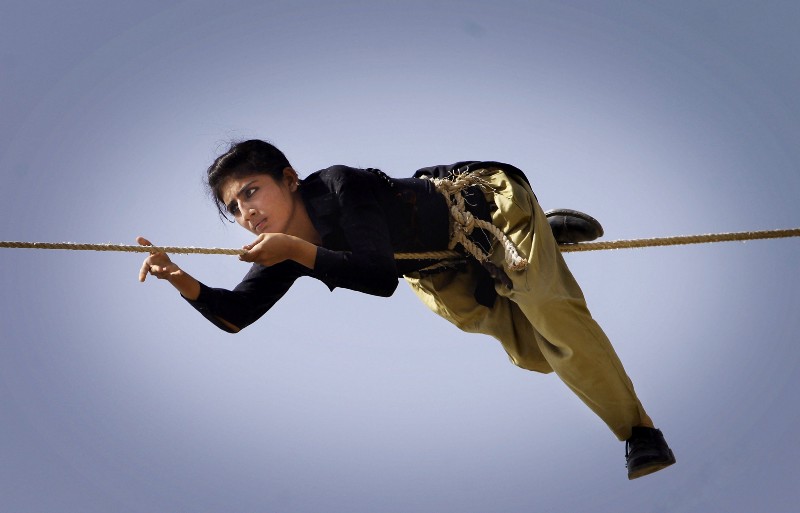
According to a report released on Wednesday, less than one percent of Pakistan’s police force is comprised of women even though they are supposed to make up 10 percent of law enforcement as part of a national quota.
A study of four South Asian countries by the Delhi-based Human Rights Initiative found that Pakistan had the lowest rate of women police officers. On average, only nine percent of police are women, according to the United Nations 2015 report on the Progress of the World’s Women.
The dearth of policewomen in Pakistan is especially problematic because only women officers can file claims on behalf of women as per a policy instated by Benazir Bhutto, the country’s first — and only — female prime minister. The creation of all-women police stations was intended to ensure that women would feel comfortable registering complaints in an overwhelmingly patriarchal society, but in practice, women officers maintain little of the authority of their male counterparts.

“A woman can come here and tell her problems to us more easily, and we have an easier time understanding her issues than male police officers,” Bushra Batool, the police chief of an all-female police station in Rawalpindi, Pakistan, told me last year. “Women tend to be threatened and discriminated against at all-male police stations.”
She said the majority of the cases her force deals with are matters of domestic abuse, sexual violence, and disputes between women, but added that it’s rather rare for women to bring their claims to the police — even if they know they’ll only have to speak with women officers.
“In Pakistani society it’s not acceptable to men that their wives or sisters or daughters would file police reports, especially when it comes to cases of domestic violence,” Batool said.
While women might manage to make their way to the police station without the men in their lives finding out, once an investigation begins, many of them are pressured into dropping charges.
Even if a woman is being beaten and psychologically tortured, she’s told to consider her husband’s honor and not go to the police station.
One of the first cases Batool dealt with when she became a police officer about 10 years ago came from a woman who claimed her husband of 10 years physically abused her. A medical team supported her claim but then it was time to go to court, the woman — though visibly bruised — said she no longer wanted to go through with the ordeal.
“I pulled her aside and asked her if she was really willing to drop the case,” the gray-uniformed officer recalled. She said she’ll never forget the woman’s response.
She told Batool flatly, “I have to keep my home together.”
The mother of four dropped the charges she had filed against her husband and went home.
Batool’s role as an officer has given her troubling perspective on the desperate circumstances that many women in Pakistan are forced to suffer due to the social customs that tend to favor men.
So many women were reared to subjugate their views to those of their husbands that many end up never speaking up against the violence they face.
“Even if a woman is being beaten and psychologically tortured, she’s told to consider her husband’s honor and not go to the police station,” Batool said.
The statistics back up that abysmal reality.
More than half of Pakistani women who are the victims of violence never tell anyone about it, according a country-wide survey. A full one-third of women who had been married reported having experienced domestic violence. Even more alarming, 43 percent of women and one-third of the men surveyed believed that a husband is justified in beating his wife if she argues with him, neglects her children or in-laws, refuses to have sex with him, or even if she burns food.
Although charged with ensuring the rights of women, many policewomen are not exempt from the patriarchal attitudes faced by those they serve. Even though policemen overwhelmingly believe that more women should work in law enforcement, less than half said that they would encourage a member of their own families to do so. One-fourth of them had reservations about working alongside women officers.
Even as officers like Batool encourage women to stand up for their rights, many of them are unwilling to do so themselves.
Of the 17 percent of Pakistani policewomen who said they had been harassed on the job, only half of them complained about the treatment they received.
Batool was one of them. Early in her career, an officer of a higher rank than her sent her sexually suggestive text messages. She reported them to her supervisor who noted her courage when he recommended her for a promotion within the force.