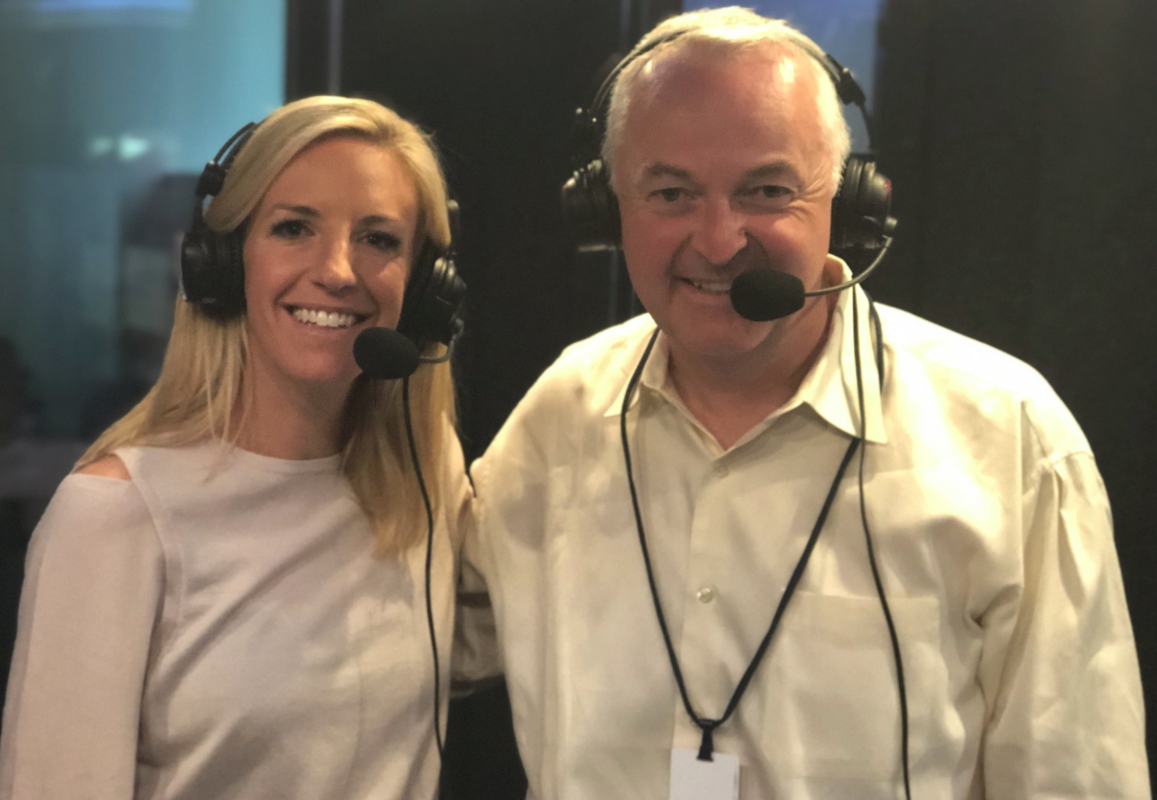
The next Women’s World Cup isn’t for another year, but the ongoing men’s World Cup has still been a breakthrough tournament for women — in sports broadcasting, that is. In the United States, former U.S. national team star Aly Wagner and Argentinian sportscaster Viviana Vila are the first two women to serve as game analysts during a men’s World Cup match, for Fox Sports and Telemundo, respectively.
And globally, they’re not alone. In England, Vicki Sparks became the first female commentator for a live, televised World Cup match for the BBC, and in Germany, Claudia Neumann made history as the first female to call a men’s World Cup match when she called Argentina versus Iceland. Plus, according to the Hollywood Reporter, Argentina has doubled the number of female journalists it has covering the World Cup — from five to 10, but still. Doubled!
It can sometimes feel patronizing to celebrate such seemingly minuscule steps forward; in 2018, should it really be noteworthy to have a woman serve as a game analyst for a men’s sport? And yet, the women who are blazing these new trails believe no amount of progress should be taken for granted.
“I think it’s really important to have men and young boys and teenagers … hear women’s voices in the sports world on the level of analyst,” Wagner told the New York Daily News before the World Cup.
“I am very happy and grateful because not everyone looks to a woman, not everyone takes a risk,” Viviana Vila told Dr. Brenda Elsey, associate professor of history at Hofstra, on the Burn It All Down podcast. (For the sake of disclosure, I co-host the podcast with Elsey.)
Yes, it’s still considered “risky” to hire a female to work in sports. The machismo associated with sports might be driven in large part by the pay gap between male and female athletes or the exposure gap between men’s and women’s sports leagues. But it’s perpetuated by limiting the people who are allowed to shape — or even participate in — the conversations about sports that matter. In the United States, only 10 percent of sports journalists are women. And, while there aren’t many global statistics, it’s safe to assume this is an area where we don’t trail behind the rest of the world.
To nobody’s great surprise, there are plenty of people who are not celebrating the advancement of women in sports media this World Cup.
Eniola Aluko, a 31-year-old English soccer player, served as a studio analyst with ITV throughout most of the World Cup. Early on, Patrice Evra, who was appearing alongside her as a pundit, was so outwardly shocked that Aluko knew what she was talking about and provided in-depth analysis that he clapped.
“This is just amazing, I think we should leave Henri, because she knows about more football than us! I’m really impressed you know,” Evra said. He was criticized for his patronizing behavior, and rightly so — expressing surprise at Aluko’s brilliance just showcased how uncomfortable Evra was sharing the punditry role with a woman in the first place.
Huge thanks @itvfootball for a dream experience working at the best World cup of all time! Such a privilege to work with you all again after Euro 2016. I enjoyed every single second! Thank you also @talkSPORT Time to switch my brain off and watch the WC from the beach😎⚽️ BRB pic.twitter.com/uFbEl45Fhi
— Eniola Aluko (@EniAlu) July 5, 2018
Vila says that throughout her career, she’s gotten the most push-back when she’s been the one to express an opinion or provide analysis; women who serve merely as hosts or reporters are more accepted in the industry, she says.
“The biggest obstacle is when a woman opines, when she makes a judgment, when a woman says what she thinks about a sport that was almost always for men,” Vila said.
“There are many men offended by my presence and the presence of many other women. Basically, it is when I analyze. If I only reported, it would have been easier. The opinion is what generates so much rejection from them. There’s not so much questioning, but a lot of ridicule.”
But that doesn’t mean it’s smooth sailing for women who stick to straight reporting. Men will often, without even realizing it, find absolutely any reason to discount the words of a woman.
Jason Cundy, a former soccer player for Chelsea and Tottenham, wasn’t thrilled by hearing Sparks call a match on the BBC.
“I found it a tough listen. I prefer to hear a male voice. For 90 minutes listening to a high-pitched tone isn’t what I want to hear,” Cundy said on live television, while siting next to women, while doing a job he was being paid real money to perform. “When there’s a moment of drama, which there often is in football, I think that moment needs to be done with a slightly lower voice.”
Cundy has, of course, apologized and correctly called himself an “idiot,” but the reason his comments shouldn’t be washed away with a simple “I’m sorry” is because they didn’t happen in a vacuum.
Female reporters at the World Cup — yes, this World Cup — have been assaulted, on camera, just for doing their jobs. We still live in a world where too many men feel entitled to a woman’s body but aggrieved when they have to hear her voice. Where her opinions — especially on sports played by men — are discounted or belittled merely because of her gender. Where some are surprised that a woman who plays the sport professionally is worthy — or even merely capable — of talking about it. Women aren’t just the minority in the sports media world; they’re deliberately and repeatedly minimized by those in positions of power.
All of which is to say, it’s worth amplifying and celebrating the voices that do get a platform. Turning on a World Cup game and hearing Wagner and Vila provides undeniable, inescapable proof that women belong in this world, too. As a female fan — and fellow sports reporter — that’s far more than just a symbolic victory.