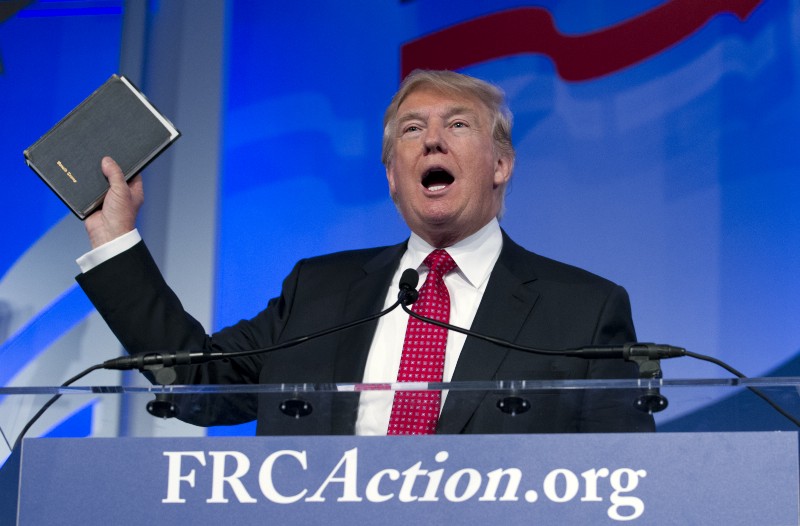
One of the highest elected leaders in the Presbyterian Church (USA) is calling out Republican presidential candidate and fellow Presbyterian Donald Trump, implying his incendiary comments about immigrants put him at odds with church teachings.
On Friday, Rev. Gradye Parsons published an open letter on the PC(USA) website addressed to Trump, who has long identified as a Presbyterian. Parsons, who is the Stated Clerk of the PC(USA) — one of the two most influential elected positions within the denomination — used the letter to highlight the denomination’s relatively progressive “policies on refugees and immigrants.”
“I am the Stated Clerk of the Presbyterian Church (USA), the denomination of the congregation in Queens, New York, where you were baptized,” Parsons wrote, speaking of Trump. “Knowing our Lord was once a refugee, faithful Presbyterians have been writing church policy urging the welcome of refugees and demanding higher annual admissions into the United States since the refugee crisis of World War II.”
Faithful Presbyterians have been writing church policy urging the welcome of refugees … since the refugee crisis of World War II.
Parsons’ deftly worded letter appeared to be a response to Trump’s often inflammatory characterizations of immigrants. During his campaign announcement speech in June, Trump referred to immigrants as “rapists” who “are bringing drugs” to the United States, and later unveiled a widely criticized immigration plan that calls for the forced expulsion America’s roughly 11 million undocumented immigrants. Trump took a similarly deportation-focused approach to the growing immigrant crisis in Syria, declaring this week that he would send all refugees from the war-torn country back to their embattled home if he becomes president, saying, “listen, they could be ISIS.”
But as Parsons points out, even though such statements are popular among some Republican voters, they don’t necessarily make Trump a very good Presbyterian. The stated clerk noted that Presbyterians have had a mission presence in Syria and other Middle Eastern nations “since 1823,” and that the denomination has pushed for comprehensive immigration reform in the United States that includes a pathway to citizenship for undocumented immigrants — not widespread deportation.
“Presbyterians through decades of policy have demanded humane treatment of people of all nationalities and faiths who find themselves within our borders,” he wrote. “We have challenged our government when it neglects to acknowledge the refugee status of those fleeing persecution. We have pushed for due process at the border and we continue to petition for immigration reform that includes a path to citizenship for undocumented persons.”
“I hope you will find this helpful,” Parsons, who recently announced he would not seek reelection, concluded. “I especially hope it will inform you on your policies going forward.”
Parsons’ letter, while carefully worded to avoid any explicit candidate endorsement or outright condemnation of Trump, is a rare move for the denomination. Although the PC(USA), like most mainline Protestant Christian groups, is generally progressive and advocates for many public policies, its hierarchy tends to avoid discussions specific candidates during election season, wary of violating laws that could jeopardize their tax-exempt status.
Yet Trump has repeatedly cited his Presbyterian faith when speaking to churchgoing Republican voters, and claims to attend Marble Collegiate Church in Manhattan — a Reformed Church in America congregation. But that church has stated that he is not an “active member” of their worship community, and the left-leaning PC(USA) publicly diverges from Trump on several policy issues other than immigration: Trump, for instance, officially opposes marriage equality, whereas the PC(USA) both ordains LGBT ministers and allows clergy to officiate same-sex weddings.
Despite Trump’s gaffe–ridden discussions of religion, the businessman continues to win a surprisingly large percentage of white evangelicals. But the political and spiritual winds may be shifting: Trump is slowly hemorrhaging evangelical voters to fellow GOP candidate Ben Carson, a Seventh-day Adventist, who questioned the validity of “The Donald’s” faith during a recent press conference. In addition, prominent Southern Baptist leader Russell Moore has called for his fellow religious conservatives to abandon their support for Trump, saying, “To back Mr. Trump, these voters must repudiate everything they believe.”