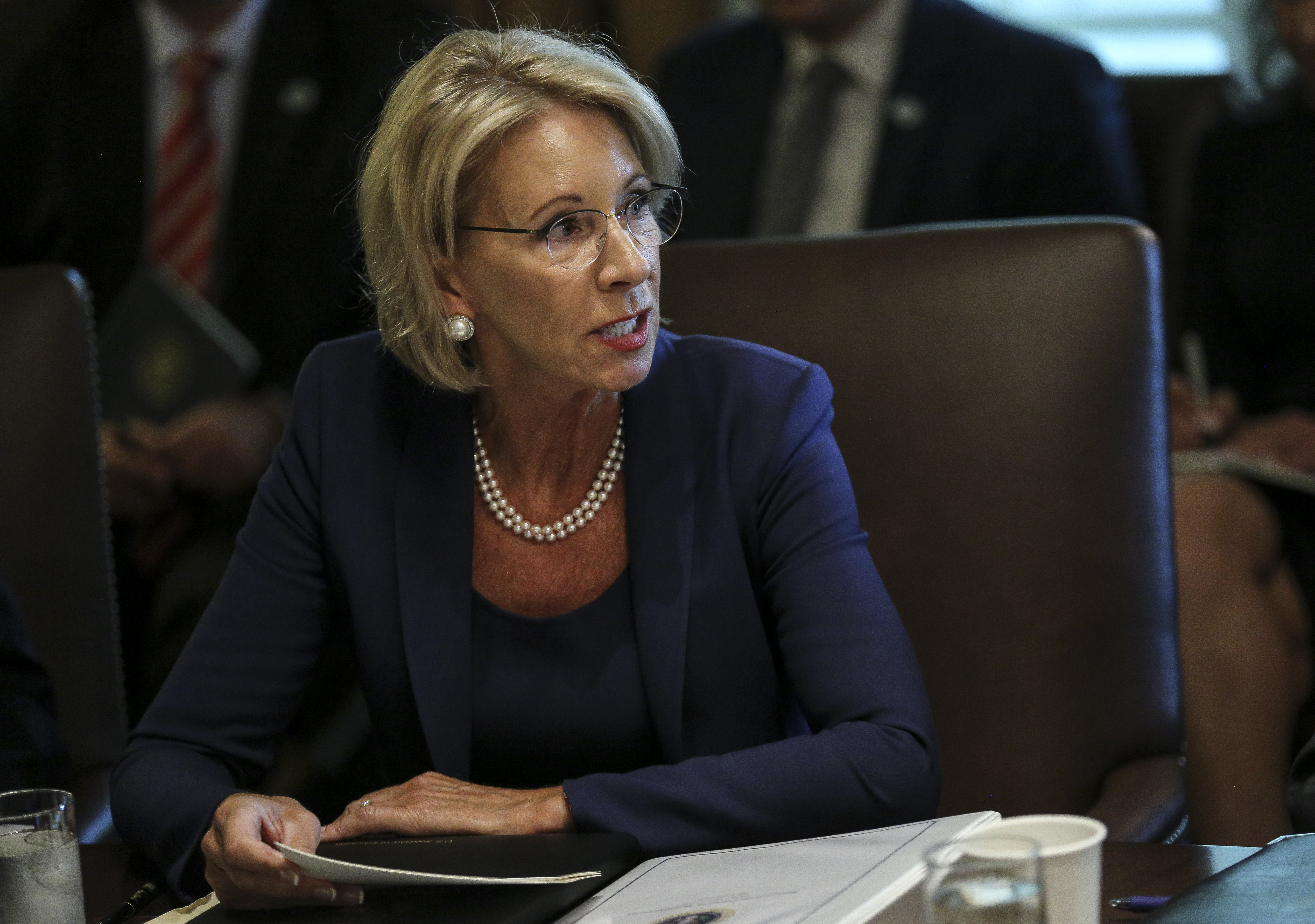
The Education Department is considering policies that would narrow the definition of sexual harassment, require a higher standard for establishing whether or not the accused is responsible for sexual assault, and make it harder for survivors to hold schools accountable for sexual assault.
On Wednesday, The New York Times reported that it has seen the department’s proposed rules on campus sexual assault, which are a continuation of the work Secretary of Education Betsy DeVos began on the issue last year. The report comes out as a number of universities’ faculty members have been accused of sexual harassment and violence.
In the summer of last year, DeVos met with advocates of sexual assault survivors, but she also met with men’s rights activists who have defended men responsible for intimate partner violence and who argue that attorneys should be able to ask sexual assault survivors “detailed, often intrusive questions about the accuser’s prior sexual history.” In September of last year, the department rescinded Obama-era guidance that clarified the protections sexual assault survivors should be granted under Title IX, the federal civil rights law that prevents sex and gender discrimination in education.

The department also released interim guidance that would replace the 60-day timeframe for prompt investigations with “no fixed timeframe,” allow schools to decide to pursue an informal resolution such as mediation for survivors to “work things out” with the accused, and allow colleges to implement a process that permits only the accused to appeal a decision.
Under the interim guidelines, colleges would also have the option of using a greater burden of proof standard. The Obama administration guidelines clarified that universities should be using the preponderance of the evidence standard, which means that it’s more likely than not that the accused is responsible for sexual assault. (Bush-era policies also emphasized this as the appropriate standard under Title IX.) But DeVos allowed colleges to use a clear and convincing evidence standard, which means evidence must be presented that will lead people to believe there is a high probability that the victim was sexually assaulted.
The policies that are currently being considered keep these parts of the interim guidance about mediation, and also allows alleged sexual assault survivors and the accused to “cross-examine each other” and request evidence from each other, according to the Times. As to whether survivors and the accused can appeal a decision — that’s up to the school. It also continues the part of the interim guidance that allows schools to choose between the two evidentiary standards.
In September, after the interim guidance was released, Michele Landis Dauber, a Stanford University law professor, told ThinkProgress that if universities can use a different standard, there would be implications for other incidents involving discrimination, as “sexual violence, racial harassment, sexual identity harassment, gender identity harassment, and disability harassment — all of these are legally adjudicated under same basic set of rules.”
As the Times reports, the rules currently under consideration “propose that a school’s choice of evidentiary standard must apply to any investigation of civil rights violations.”

Instead of using the definition of sexual harassment that means “unwelcome conduct of a sexual nature,” which as Alyssa Peterson, policy and advocacy coordinator for Know Your Title IX explained to ThinkProgress in 2016, is a standard that has been widely used in sexual harassment cases since the 1990s, the department would narrow the definition. The Times reported that this new policy would define sexual harassment as “unwelcome conduct on the basis of sex that is so severe, pervasive and objectively offensive that it denies a person access to the school’s education program or activity.”
These rules would also only hold schools responsible for looking into conduct that happened on campus and within their programs and state that legally, schools can only be held responsible for reports of which school officials have “actual knowledge,” rather than the standard that a school “reasonably should know” about alleged harassment. According to the Times, that standard goes back to 2001. Advocates for survivors of sexual assault point out that most students live off campus, so this policy would likely let a lot of schools off the hook for sexual assault.
Eighty 👏🏽 Seven 👏🏽 Percent 👏🏽 of college students live off campus. Sexual assault isn’t worse when it happens in a dorm than when it happens in your apartment down the street. It doesn’t make it easier to focus in Calculus when your rapist sits behind you.
— Sejal Singh (@Sej_Singh) August 29, 2018
The National Women’s Law Center, a non-profit that advocates for women’s rights, tweeted in response to the news that the policy “favors accused rapists.”
BREAKING: Early reports of Betsy DeVos's draft #TitleIX regulations reveal that the Trump administration continues to favor accused rapists over protecting survivors and making schools safe. https://t.co/E3nD3iCCWl
— NWLC (@nwlc) August 29, 2018
Pennsylvania Governor Tom Wolf (D) tweeted that it is “a betrayal of victims.”
I'm baffled the federal gov't wants rollback protections for victims of campus sexual assault. This is a betrayal of victims & the complete wrong direction we need to go to combat sexual assault on campuses. I urge @BetsyDeVosED to stand with victims & put a halt to this plan. https://t.co/wjfEBZKY5r
— Governor Tom Wolf (@GovernorTomWolf) August 29, 2018
Sen. Patty Murray (D-WA) called the draft rules “shameful and appalling.”
It’s shameful and appalling that @BetsyDeVosED is still considering issuing a rule would make it harder for students to seek justice if they’ve been sexually assaulted on campus. https://t.co/scjrDnj59w
— Senator Patty Murray (@PattyMurray) August 29, 2018
The rules will eventually go through a public comment period, the agency must respond to comments, and they can be enforced as law, although it’s unclear whether the draft rules the Times reported on will be the same rules that will eventually be released to the public. Liz Hill, department spokesperson, told the Times the information was “premature and speculative” and that the department is “in the midst of a deliberative process.”