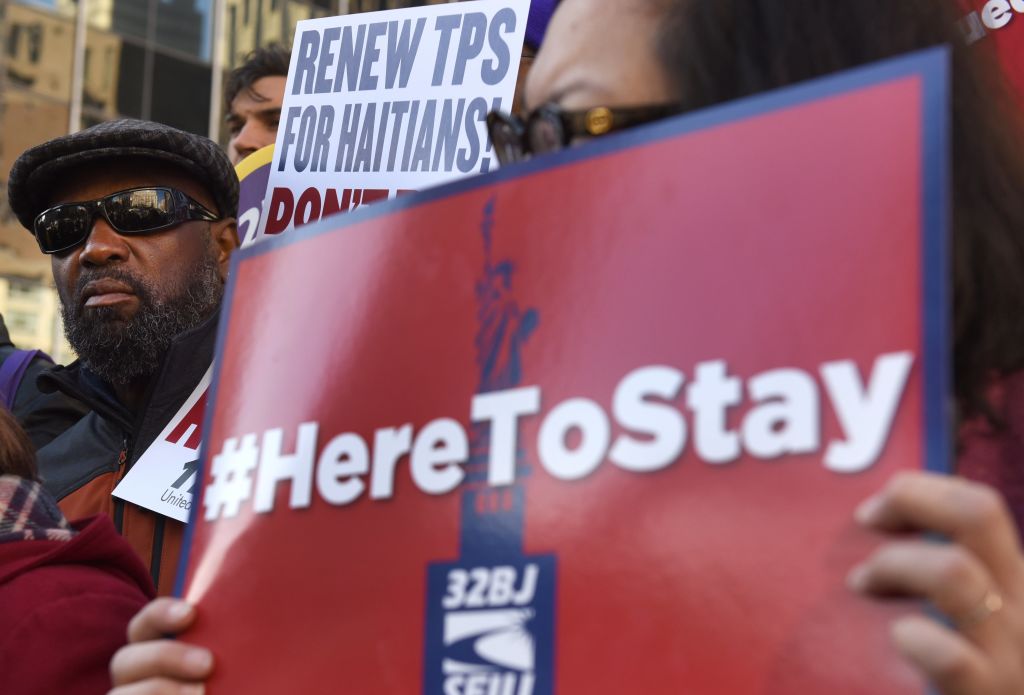
For members of tight-knit Haitian American communities across the United States, President Donald Trump’s description of their ancestral homeland as a “shithole” was neither surprising nor out of character for the man many are convinced is a racist.
“It’s sad and it’s shameful,” said a forlorn Gepsie Metellus, executive director of the Sant La Haitian Neighborhood Center in Miami, Florida. “That clearly was just another racist statement made by the president. I was not shocked because he’s made so many of them.”
Metellus was one of a handful of Haitian Americans who expressed anger and outrage during interviews with me on Friday, following news reports that Trump uttered the profane comment to question why people from Haiti and other, unspecified African nations should be allowed to immigrate to the United States.
During a Thursday meeting with Congressional leaders to discuss immigration issues, Trump responded to a question about immigration from Haiti and Africa by wondering aloud why the United States should allow “all these people from shithole countries” into the country. In the same meeting, Trump said, according to news accounts quoting the meeting’s participants, that the nation should admit more people from countries such as Norway, which is overwhelmingly populated with white people.

Metellus said she was in her office when news of Trump’s comments came on television and some staffers brought it to her attention. In that moment, she was nonplussed. “I just thought, Trump is at it again,” she said. “So this just what he said now. Nothing new there.”
But as the evening wore on, she became increasingly dispirited as media accounts of the comment circulated within her Miami community. People were talking more and more about it — even people from outside the country were consumed by it, Metellus said.
“For a man whose slogan is to make America great, he’s making the world shake its head and say, how unfortunate for America to have a racist as president,” she said.
Rachel Decoste, a Haitian Canadian who lives in Washington, D.C. and consults on immigration issues, told me that the timing of Trump’s comment — the news broke the night before the eighth anniversary of a deadly earthquake that killed an estimated 300,000 people and drew global attention to the impoverished island nation — was more hurtful than what he actually said.
“This is a day that the community looks forward to with a lot of trepidation and mixed feelings,” Decoste said. “So when I saw that Haiti was trending on Twitter, my first thought was, please don’t let them have another earthquake. Then I saw that it was the president’s comments, I was deflated, disappointed, and just really in disbelief that he would say something like that at a time like this.”
Of course, Decoste added, she doubted the disparaging comment was timed to the anniversary of the Haitian earthquake or the upcoming weekend’s commemoration of Dr. Martin Luther King Jr.’s birthday. “I seriously doubt he’s that aware of what the significance of the dates are,” she said. “I think his ignorance is the problem. If there’s anything to be done about what he said, it would be good for some sort of education exercise that informed him about the reality of the world outside his head.”
“I think his ignorance is the problem.”
That education ought to include some facts and figures about the Haitian community in the United States, such as an acknowledgment that slightly less than one million Haitian immigrants live in this country and that some 50 Haitian Americans are elected officials nationwide.
U.S. Rep. Mia Love (R-UT), the daughter of Haitian immigrants, is one of those elected officials. She demanded Trump apologize for his comment. While stopping short of calling him a racist, Love characterized his comment as “unkind, divisive and elitist.”
Here is my statement on the President’s comments today: pic.twitter.com/EdtsFjc2zL
— Rep. Mia Love (@RepMiaLove) January 11, 2018
In Philadelphia, Numa St. Louis, a Haitian American who serves as district representative for Rep. Dwight Evans (D-PA), said he was in a meeting when he heard about Trump’s disparagement of his ancestral home.
“My phone blew up with comment,” St. Louis told me. “People were outraged, but I was not surprised. It just confirmed what many of us already knew. Fact of the matter, the Haitian community is just the latest victim of this racist outlook that the president holds toward people who aren’t white.”
In Miami, Haitian American writer and activist France Francois couldn’t contain her outrage, so she took to Instagram to share it with her followers. In pointed remarks that linked Trump’s comment with the devastation of the earthquake, Francois posed a philosophical question to Trump: “What makes a country a #shithole?🤔🤔🤔 Is it how many resources countries like yours were able to extract from it to establish your riches?”
Despite the clock-like predictability of Trump’s racist comments, his hateful description of Haiti is the lesser of the problems within his administration. The larger concern for Haitian Americans and others threatened by Trump is that he has the potential to follow up on whatever terrible threats come out of his potty mouth — such as ending temporary protected status for Haitians and other immigrants — to threaten the lives of so many people. Hearing vile things Trump says may be hard to ignore, but don’t turn a blind eye to how he acts on those feelings.