by Cole Mellino
Proponents of local food production have long argued that you drastically decrease your carbon footprint by eating locally-sourced food.
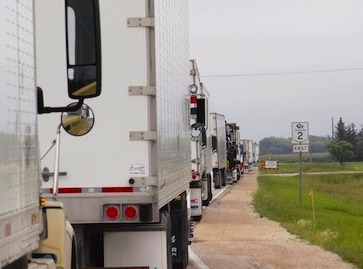
There have been numerous studies in recent years showing that non-local food, especially imported food, which is making up a larger and larger percentage of Americans’ diets, has a much higher emissions impact than locally produced food. A study from the National Resources Defense Council (NRDC) has the numbers to prove it. Here is some of the data on the staggering impact imported food has in California:
- In 2005, the import of fruits, nuts, and vegetables into California by airplane released more than 70,000 tons of CO2, which is equivalent to more than 12,000 cars on the road. These are all foods that can be grown in California
- Almost 250,000 tons of global warming gases released were attributable to imports of food products — the equivalent amount of pollution produced by more than 40,000 vehicles on the road or nearly two power plants
- More than 6,000 tons of smog-forming nitrogen oxides were released into the air — the equivalent of almost 1.5 million vehicles or 263 power plants
- 300 tons of sooty particulate matter were released into the air — the equivalent of more than 1.2 million cars or 53 power plants
- Approximately 950 cases of asthma, 16,870 missed schools days, 43 hospital admissions, and 37 premature deaths could be attributed to the worsened air quality from food imports, according to freight transport–related projections by the California Air Resources Board.
These numbers show the major impact that our food choices have on the environment and human health. This heavy reliance on imports is alarming considering that California is the number one state for agricultural production in the U.S. After examining the top six imports to California (table grapes, navel oranges, wine, garlic, rice, and fresh tomatoes — all grown in the state), NRDC discovered a disturbing trend:
Harmful air pollution in California produced from transporting these six foods into California was up to 45 times more than local or regional transport of California grown foods — and global warming pollution went up to 500 times that of locally grown foods when the food was imported by airplane.
In another study comparing the impact of local versus non-local produce, researchers at Virginia Tech conducted an assessment of carbon dioxide emissions of local broccoli and non-local broccoli. Here’s what they found:
The average distance traveled by nonlocal broccoli delivered to Virginia Tech during the month of October 2009 was 2786.0 miles. The total amount of carbon dioxide emitted as a result of this transport was 105,830.0 pounds. This averaged to approximately 11,758.9 pounds carbon dioxide per shipment and 15.3 pounds carbon dioxide per pound of broccoli delivered.
In contrast to the high mileage of non-local broccoli:
The distance traveled per trip by the cargo van transporting the local broccoli was 19.1 miles. The amount of carbon dioxide emitted per trip was 23.2 pounds, which added up to 258.3 pounds of carbon dioxide emitted during all transport occurring in the month of October. Per pound of broccoli, 0.04 pounds of carbon dioxide were emitted.
This is a very specific case study. But it shows how local food can substantially reduce emissions. Just look at this map of the non-local broccoli’s trek across America when it can be grown in Virginia to be eaten in Virginia.

And here’s the much more sensible journey of local broccoli:

There is, however, valid criticism of the idea that local food is always the best. Christopher Weber and H. Scott Matthews, of Carnegie Mellon University did a life-cycle analysis of the average American diet by tracking greenhouse gas emissions through all phases of a food’s production, transport, and consumption. Weber and Matthews found that overall, transport accounts for about 11 percent of the food system’s emissions. Agricultural production accounts for the bulk of greenhouse gas emissions, or 83 percent. They found that the kind of food is much more important than where it comes from. A diet containing meat and dairy products is much more resource intensive than a plant-based diet. The Worldwatch Institute’s article on Weber and Matthews’ report sums it up well:
Weber and Matthews calculated that reducing food miles to zero-an all-but-impossible goal in practice-would reduce the greenhouse gas emissions associated with the food system by only about 5 percent, equivalent to driving 1,000 miles less over the course of a year.
By comparison, replacing red meat and dairy with chicken, fish, or eggs for one day per week would save the equivalent of driving 760 miles per year. Replacing red meat and dairy with vegetables one day a week would be like driving 1,160 miles less. “Thus,” they write, “we suggest that dietary shift can be a more effective means of lowering an average household’s food-related climate footprint than ‘buying local.’”
So yes, eating less meat and dairy will greatly reduce the impact your diet has on the planet. However, the combination of choosing the right foods with a local approach will have the biggest impact:
Weber acknowledges, “These calculations were done assuming that local foods are no different than non-local foods.” And that’s not usually the case. For example, local-food advocates also emphasize eating seasonal (often meaning field-grown) and less-processed foods. Those qualities, along with shorter distances from farm to table, will also contribute to lower emissions compared to the “average” diet.
Separating the debate into an either/or is a red herring. Ideally, we’d do both.
Cole Mellino is an intern on the energy team at the Center for American Progress