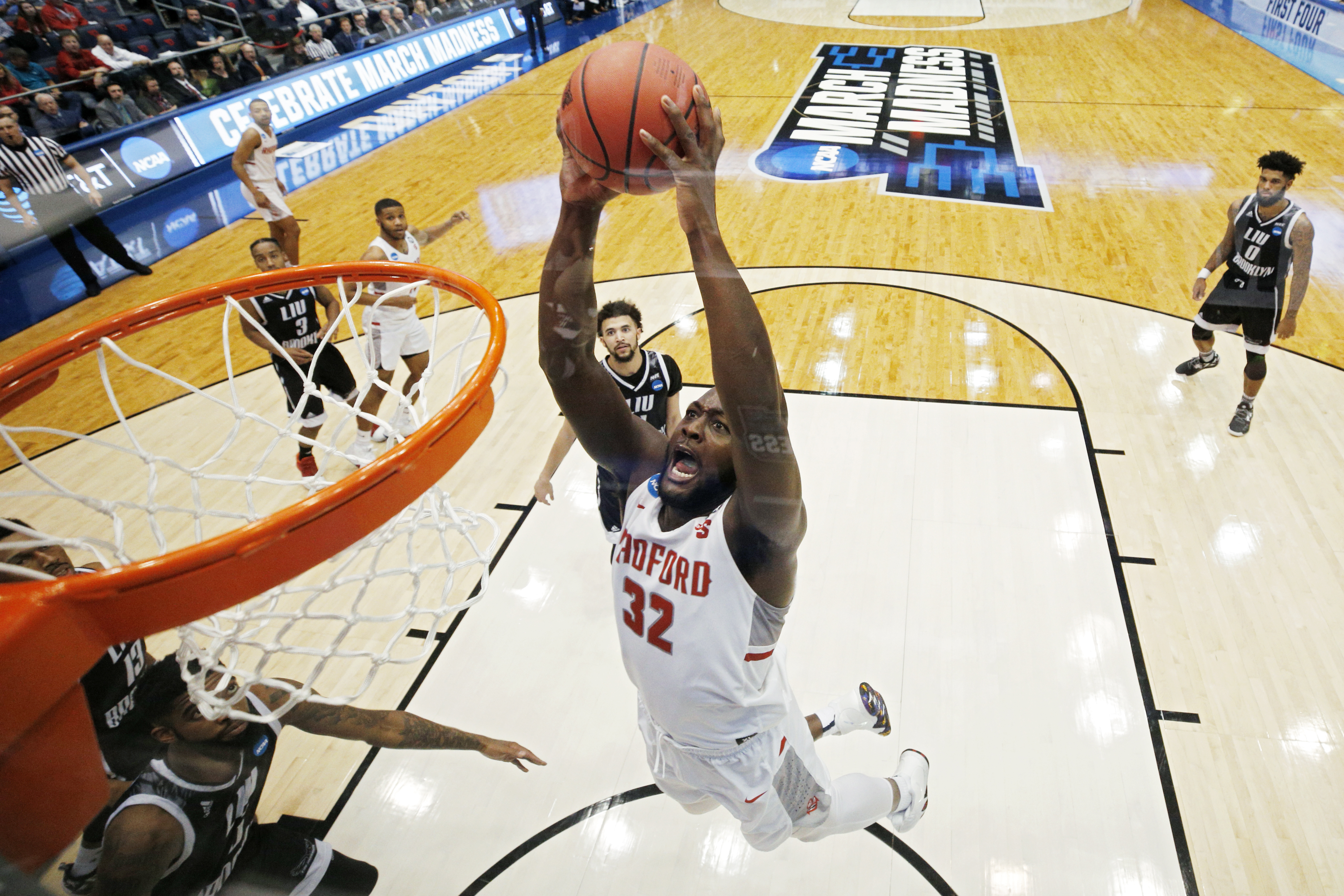
As you may have heard, it’s March. And if upsets, referees, and Grayson Allen haven’t already left your bracket in shambles, a new, unlikely villain has emerged to inject fresh madness into March: The FBI.
This particular dance began last September, when the U.S. Department of Justice announced it was pursuing criminal cases against dozens of people and organizations involved in the college basketball industrial-complex, including coaches, shoe company executives, and agents. The widespread investigation involving wiretaps and whistleblowers is likely to take years, and could implicate some of the most recognizable names in your bracket, such as Duke, Arizona, Kentucky, Texas, Alabama, Oklahoma, and…well, according to those familiar with the case and the world of college basketball, the list will go on and on.
“The NCAA investigates who they want to investigate, and crack downs on who they want to crack down on, but the FBI doesn’t have a dog in the fight,” Ed O’Bannon, a member of the 1995 UCLA national championship team and author of Court Justice: The Inside Story of My Battle Against the NCAA with Michael McCann, told ThinkProgress. “Who polices the NCAA? Nobody does. It seems like the FBI is saying, enough is enough.”
This just in: The NCAA is corrupt and the FBI is on it, so if you’re part of the “stick to sports” crowd, you might consider muting the basketball commentary the next two weeks.
Currently, the investigation centers on systematic bribery plots to steer players to specific schools, for the benefit of agents, sportswear companies, and the coaches at the school. These “plots” involve anything from an agent buying a player lunch, to a shoe company paying an assistant coach somewhere in the $20,000 range, to even a head coach allegedly guaranteeing $100,000 to a star player.
If none of that seems particularly egregious given that the three week-long NCAA tournament alone is a billion-dollar enterprise, well, that’s probably because you’re good at keeping things in perspective. NCAA laws aren’t federal laws, and paying for talented athletes to come to your school to play basketball in order to enrich everyone around them doesn’t seem like the biggest scandal threatening the safety of our nation right now. Honestly, the players, coaches, agents, and brands are all doing what they can within the ridiculous regulations the NCAA provided them with. So what, exactly, is the FBI’s plan here?
Officially, the government is charging the defendants with fraud. And they’re treating the universities — who employ the coaches and benefit mightily from the success of programs such as men’s basketball and football — as the victims of said fraud.
If you’re having a hard time grasping that logic, Randall D. Eliason — a former Assistant United States Attorney for the District of Columbia, where he served as Chief of the Public Corruption/Government Fraud section — broke it down in his blog, Sidebars.
The planned payments to the students and their families were not illegal. But they would make the students ineligible athletes under the NCAA rules. Those rules require student athletes to be amateurs who do not receive any payments or other benefits for their participation in college sports. A university found to have ineligible players on its team is subject to sanctions including financial penalties, limitations on post-season play, and limitations on financial aid that may be awarded to other athletes. The potential harm that could result from such rules violations is what forms the basis of the government’s fraud allegations.
Eliason, it must be said, does not find this to be a convincing argument, for multiple reasons: It separates the coaches from the universities, which feels arbitrary considering how much coaches are paid and how closely tied they are with top university officials. Plus, the scheme wasn’t intended to hurt the university — quite the opposite, the intention of luring top players is to help the university win basketball games, and thereby sell tickets and earn money. He argues that, while the defendants should suffer consequences and the NCAA should be burned to the ground — okay, Eliason said “clean house,” — they “shouldn’t be facing a twenty-year felony for conspiring to ‘defraud’ universities whose own coaches were actively working with them towards the same goal.”
He’s not the only one questioning why the FBI is spending so much time and money on this case.
“Conflating NCAA violations with the kind of crimes the FBI is supposed to pursue is a mug’s game of the first order,” Charles Pierce wrote in Sports Illustrated. “The FBI is operating as the enforcement arm of the NCAA, and that’s just crazy.”
Ultimately, because universities are supposedly a victim in all of this, they can scapegoat everyone else — agents, coaches, trainers, even players. Essentially, as O’Bannon said, the FBI can do the NCAA’s bidding for it.
Look, nobody is saying that the corruption in the NCAA system shouldn’t be investigated. It’s just that the investigation needs to center around protecting the players, not behemoth universities. The entire system of amateurism must go. Last year, the NCAA topped $1 billion in revenue. The players should absolutely get a portion of that. They should also be able to profit off of their likeness. Fixing amateurism would not be nearly as difficult as NCAA defenders (who, miraculously, still exist) are making it out to be — read this excellent article by Patrick Hruby if you disagree.
And, a scholarship is not adequate compensation for these athletes, because for the most part, they are not permitted to make education a priority.
O’Bannon, who was the lead plaintiff in the O’Bannon vs. NCAA antitrust class action lawsuit against the NCAA, said it was clear to him before he even stepped foot on UCLA’s campus that classes were merely a formality — after all, he couldn’t take the ones he wanted to because he had to schedule around practices
“Right away, that’s when it’s evident that I’m here for my basketball, not for anything scholastic,” he said.
The NCAA is a sham, and it always has been. The only hope is that this FBI investigation will expose it for what it is, and one way or another, trigger the beginning of the end of the madness.
“Now we’ve had these FBI probes come to the forefront of our game — that is sad and unfortunate, but it’s also a chance to look at the system and say, hey, it needs a serious revamp,” O’Bannon said.
“But I really have no expectations because I’ve been involved in it for so long, and there’s no evidence that anything is going to change any time soon.”