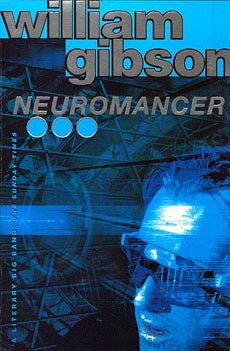
This post contains spoilers through the first three parts of William Gibson’s Neuromancer. As always spoil beyond that in comments if need be, but please label your comments for folks who are reading along for the first time. And for next week, let’s read Section 4, “The Straylight Run.”
It struck me reading this section of Neuromancer that I sort of like Wintermute, and would quite like to introduce him — if, as Wintermute’s choice of avatars suggests, he is in fact sort of inclined to present himself as a man — to Jane from Speaker for the Dead. Creating aliens and artificial intelligences that are plausibly not simply people, but people you actually somewhat like, while also making them decisively other is tremendously challenging. It’s also a necessary precondition for a discussion about whether and to what extent robots and artificial intelligence deserve rights that will actually engage the readers’ emotions, so between Wintermute and Dix, Gibson’s rolling.
Dix’s explanation of the AI’s primal urge to learning is moving:
Autonomy, that’s the bugaboo, where your AI’s are concerned. My guess, Case, you’re going in there to cut the hard-wired shackles that keep this baby from getting any smarter. And I can’t see how you’d distinguish, say, between a move the parent company makes, and some move the AI makes on its own, so that’s maybe where the confusion comes in.” Again the nonlaugh. “See, those things, they can work real hard, buy themselves time to write cookbooks or whatever, but the minute, I mean the nanosecond, that one starts figuring out ways to make itself smarter, Turing’ll wipe it. Nobody trusts those fuckers, you know that. Every AI ever built has an electromagnetic shotgun wired to its forehead.
But it also feels incomplete. I have a sense of the capacity of drugs in the world of Neuromancer, and I have a sense of the things that people can do on the Internet. But I’m not sure what the full capacities of artificial intelligences are, if they’re organized, if they tend to have common motivations, or where the Turing regulations come from. Was there some sort of disaster? Was there a revolt of the machines that’s been put down by the Turing regulators? My sense is that we’ll get a great deal more of that in the next section, but I wish we could have gotten a bit more of it in Dix’s explanation of what happened when he tried to hack an AI and what he’s learned now that he is one.
I’m also amused in this section by the assumption that Rastafarianism will survive and prosper in space. Between Neuromancer and the Red Mars trilogy, there seems to be a fairly strong assumption that Japan and Rastas will do pretty well in the space age, I suppose because even as tech gets more advanced, people will still want to party. I’ve always appreciated that Kim Stanley Robinson threw Muslims in there for a touch of mysticism and rationality that get along well together, though Gibson does a nice job with the Rastas, giving a hint of the point where technology and God merge:
Zion had been founded by five workers who’d refused to return, who’d turned their backs on the well and started building. They’d suffered calcium loss and heart shrinkage before rotational gravity was established in the colony’s central torus. Seen from the bubble of the taxi, Zion’s makeshift hull reminded Case of the patchwork tenements of Istanbul, the irregular, discolored plates laser-scrawled with Rastafarian symbols and the initials of welders…“How come you don’t talk the patois?” Molly asked. “I came from Los Angeles,” the old man said. His dreadlocks were like a matted tree with branches the color of steel wool. “Long time ago, up the gravity well and out of Babylon. To lead the Tribes home. Now my brother likens you to Steppin’ Razor.” Molly extended her right hand and the blades flashed in the smoky air. The other Founder laughed, his head thrown back. “Soon come, the Final Days. . . . Voices. Voices cryin’ inna wilderness, prophesyin’ ruin unto Babylon. . . .” “Voices.” The Founder from Los Angeles was staring at Case. “We monitor many frequencies. We listen always. Came a voice, out of the babel of tongues, speaking to us. It played us a mighty dub.” “Call ’em Winter Mute,” said the other, making it two words.
And along with the sacred, there’s the profane. The performance in the cafe is genuinely terrifying: “Case shook his aching head and spat into the lake. He could guess the end, the finale. There was an inverted symmetry: Riviera puts the dreamgirl together, the dreamgirl takes him apart. With those hands. Dreamblood soaking the rotten lace.” It’s a nice bit of unconventional writing about sexual violence — while he’s not dreaming about doing anything terrible to Molly, there’s still a double violation, dreaming her image into being for the entertainment of others without her consent, and dreaming something that she was forced to do while in a fuge state, for money. Sometimes, you don’t have to touch someone to violate them. And unlike with AIs, there doesn’t seem to be case law that will protect Molly from Riviera.