Despite all signs pointing to the opposite, President Donald Trump keeps claiming success in his efforts to denuclearize North Korea. As of now, negotiations have not only stalled, but seem to be rolling in the opposite direction.
This past week has brought several troubling updates on the negotiations, which weren’t particularly promising to start with.
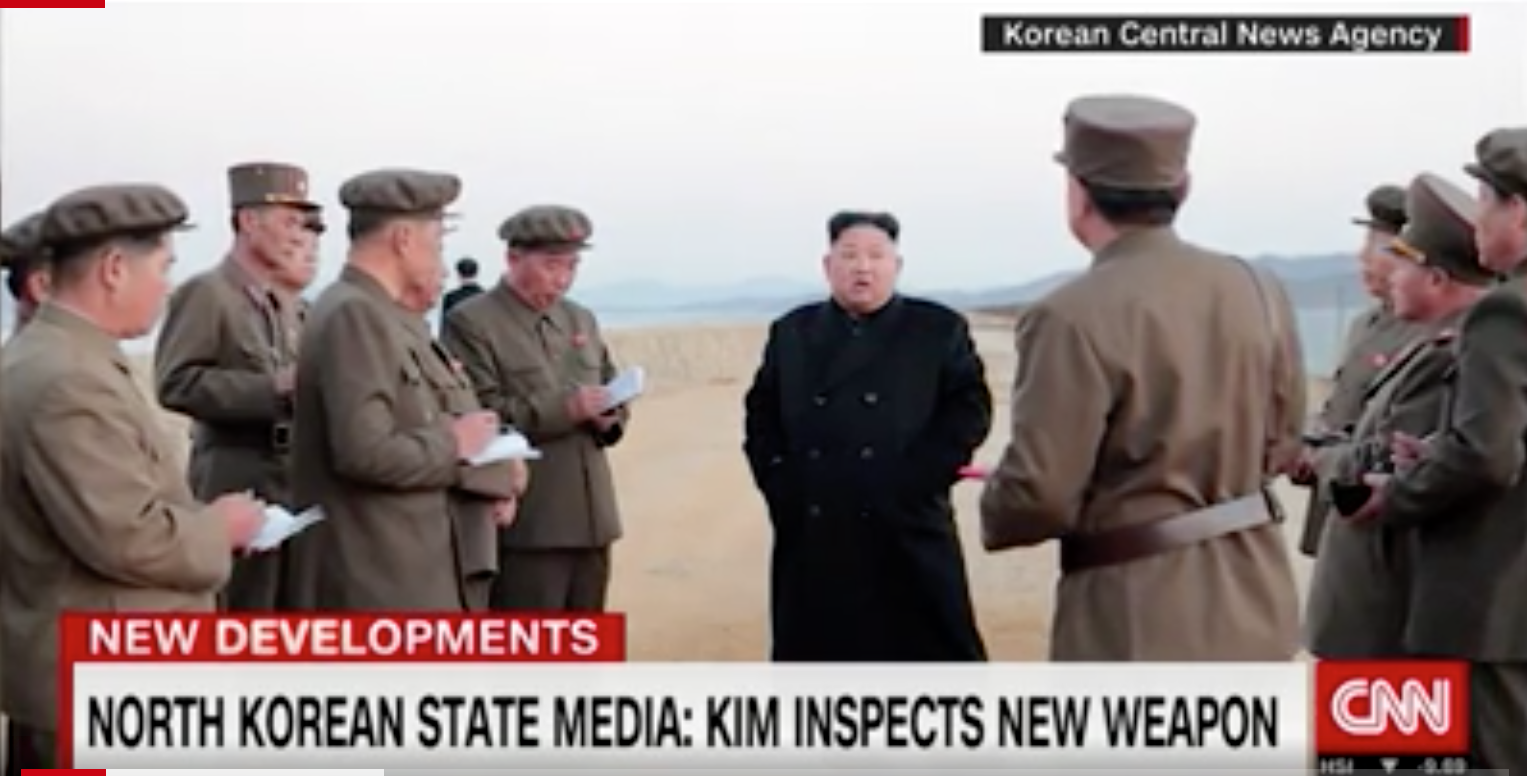
On Friday, CNN reported that that North Korea is testing a “newly developed ultramodern” weapon, with images of leader Kim Jong-un observing said weapon circulating in the media.
Just what this new weapon might be remains unknown, although one expert from South Korea told the network it is “likely to be a multiple rocket launcher,” and that Seoul does not see it as “a North Korean military provocation.”
Another expert, one from the Middlebury Institute of International Studies at Monterrey, however, told CNN that this shows that Kim is “tiptoeing towards a more aggressive posture in negotiations with the U.S.,” signaling that he wants the United States to change its approach to disarmament talks.
About that approach: Pyongyang is not going along with what it calls the United State’s “gangster-like” approach, and on Thursday, Vice President Pence said that the U.S. will no longer require North Korea to provide a full list of its nuclear and missile sites before a possible second meeting between Kim and Trump.
Things started to go wrong in the talks that followed President Trump’s love-in with Kim in the bizarre June summit in Singapore (we’re not being cute — the president has actually said that he and the North Korean dictator “fell in love.”)

There were disastrous talks in July, which Secretary of State Mike Pompeo touted as “progress” but North Korea called “regrettable” and blocked with the United State’s “cancerous demands.” The United States canceled scheduled talks in August at the very last minute, which North Korea did not appreciate.
In fact, state-run media published an editorial accusing the United States of “hatching a criminal plot to unleash a war against the DPRK [Democratic People’s Republic of Korea] and commit a crime which deserves merciless divine punishment in case the U.S. fails in the scenario of the DPRK’s unjust and brigandish denuclearization first.”
Meanwhile, North Korea continues to develop its nuclear program, and on Monday, a report by the Center for Strategic and International Security, identified 13 of perhaps 20 missile operating bases that North Korea has not declared.
President Trump, without providing any context or evidence, took to Twitter to discredit the report (which was written up in the New York Times, and in many other publications):
The story in the New York Times concerning North Korea developing missile bases is inaccurate. We fully know about the sites being discussed, nothing new – and nothing happening out of the normal. Just more Fake News. I will be the first to let you know if things go bad!
— Donald J. Trump (@realDonaldTrump) November 13, 2018
Now, whether what the North Koreans are doing can be categorized as “deception” is debated by some. As Vipin Narang, an associate professor of political science at MIT, pointed out on Twitter, Kim is basically doing precisely what he said he would do, after ordering ballistic missiles to be mass produced on January 1 2018.
Indeed, Narang points out that Trump is fully aware that Kim will never entirely disarm (North Korea has repeatedly said that it views the weapons as a necessity against existential threats):
Another hypothesis, one with which many may disagree: Trump is fully aware that Kim isn’t disarming. And he doesn’t care. So long as missiles aren’t overflying Japan and he keeps meeting with Kim, he can claim he has solved “the threat”— which doesn’t require disarmament. pic.twitter.com/UPukexrFfw
— Vipin Narang (@NarangVipin) November 14, 2018
With talk of a second summit between Trump and Kim for sometime early in the new year, the focus seems to be on just what a “verifiable plan” might be, although one of the authors of Monday’s report is worried about what that means.
“We can’t negotiate over things they don’t admit having,” said Victor Cha. “It should take us back to the initial U.S. negotiating point: We need a full declaration.”