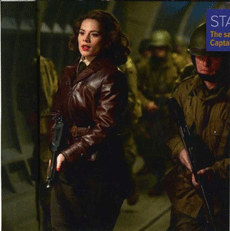
Adam Serwer thinks that I’m wrong on Captain America: The First Avenger’s optimism about American institutions because Peggy Carter, Cap’s girl, has been rejected elsewhere*:
Peggy Carter, Cap’s love interest, alludes to institutional sexism briefly in one of her first conversations with Steve Rogers, saying that she knows what it’s like to have “doors slammed in her face.” It’s easy to see how a similar scene could be constructed to explain the presence of Gabe Jones in Cap’s elite unit, something along the lines of Cap insisting that he be included because he knows what it’s like to have “doors slammed in his face,” alluding to his earlier conversation with Carter. That would be entirely in keeping with the narrative context of the movie itself, and even Cap’s character, without requiring a lengthy tangent on segregation in the armed forces during World War II.
My assumption was those doors were British ones — Peggy is, after all, a U.K. transplant to an American unit. And it’s true that Col. Chester Phillips can be skeptical of Peggy’s judgement out in the field as part of a larger skepticism of what Cap, who up until his arrival in Europe has been a war bond-shilling show pony, can actually accomplish that’s of military value. But she’s entirely accepted as a partner by Howard Stark and Dr. Abraham Erskine, and she gets to shuck that pencil skirt and put on some pants to fight Hydra on the ground. (Erskine’s top secret lab is guarded by a lady with a shotgun, too.)
In a sense, that fact that Peggy gets to hit the front lines and defend her man is just as cheery and dismissive of actual history as the suggestion that World War II units were racially integrated. Women in both the WACS and the WAVES were kept out of combat (something that actually occasioned prejudice from men who thought they’d be taken out of combat and sent to the front lines), and the WAVES were confined to the continental U.S. and Hawaii. The names of both units signaled that they were meant to be temporary units rather than to pave the way for women’s long-term service in the military. Somebody may have shut a door on Peggy Carter somewhere, but in Captain America, it sure wasn’t the U.S. Army.
*He also notes that the Marvel universe as a whole has some nicely skeptical storylines about the American government. This is indisputably true. But they have chosen a more optimistic story for their major movie venture, leaving Sony to produce the more pessimistic X-Men arc. That was all I meant.