Last week, the Senate Intelligence Committee confirmed the U.S. intelligence community’s assessment that Russia, under the direction of its president Vladimir Putin, interfered in the 2016 American election to help Donald Trump.
Then a British woman died after being exposed to the same deadly nerve agent that was used to poison a former Russian spy.
Meanwhile, President Trump continues to escalate his attacks against special counsel Robert Mueller’s Russia investigation.
Public opinion has turned strongly against the Rigged Witch Hunt and the “Special” Counsel because the public understands that there was no Collusion with Russia (so ridiculous), that the two FBI lovers were a fraud against our Nation & that the only Collusion was with the Dems!
— Donald J. Trump (@realDonaldTrump) July 7, 2018
When is Bob Mueller going to list his Conflicts of Interest? Why has it taken so long? Will they be listed at the top of his $22,000,000 Report…And what about the 13 Angry Democrats, will they list their conflicts with Crooked H? How many people will be sent to jail and……
— Donald J. Trump (@realDonaldTrump) June 28, 2018
….persecuted on old and/or totally unrelated charges (there was no collusion and there was no obstruction of the no collusion)…And what is going on in the FBI & DOJ with Crooked Hillary, the DNC and all of the lies? A disgraceful situation!
— Donald J. Trump (@realDonaldTrump) June 28, 2018
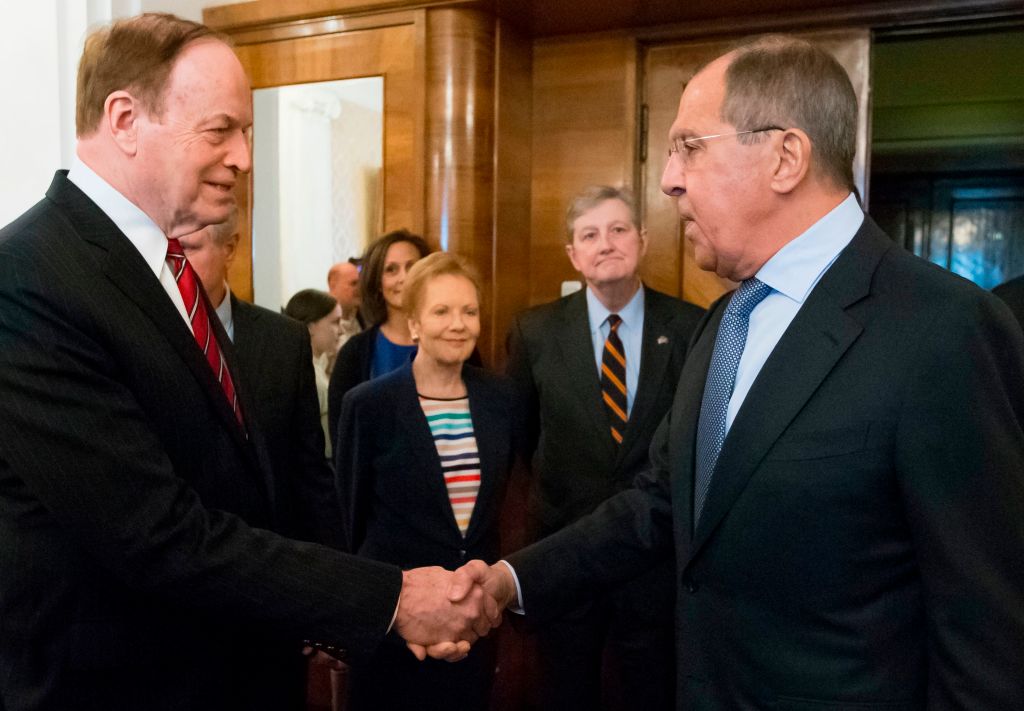
With all of this as a backdrop, it raised eyebrows when eight Republicans announced they would make a trip to Russia over the Fourth of July. However, the GOP lawmakers promised to be tough on their hosts. Sen. John Kennedy (R-LA) vowed to confront Russia over election interference. Sen. Jerry Moran (R-KS) said the evidence of election tampering was clear. Upon his return, Sen. Steve Daines (R-MT) claimed a tough message had been sent to Russia.
But these Republicans’ messages either weren’t shared by the entire delegation or got lost in translation.
Shortly before the trip, Sen. Richard Shelby (R-AL) contradicted his conservative colleagues by claiming Russia’s election interference wasn’t unusual:
“Most countries would meddle and play in our domestic elections if they could, and some of them have. We have to be realistic nations are going to do what is in their next [sic] interest; we’ve done a lot of things too.”
Shelby had a similar message upon meeting Duma speaker Vyacheslav Volodin in Moscow:
“I’m not here today to accuse Russia of this or that or so forth.”
Former Russian ambassador to the U.S. Sergey Kislyak, who met with Trump in the Oval Office last year, suggested the GOP delegation acknowledged that Russia hadn’t interfered in the 2016 U.S. election:
“We heard things we’d heard before, and I think our guests heard rather clearly and distinctly an answer that they already knew — we don’t interfere in American elections.”
Much of the drama played out in Russian media, which characterized the delegation as meek. According to Russian media analyst Julia Davis, Russian state television referred to the exchanges between the Republicans and Russian lawmakers as “warm, perhaps even tender” and implied that their guests had chickened out:
“GOP lawmakers sounded tough on Russia when speaking from Washington, but changed their rhetoric upon arriving to Moscow.”
Konstantin Kosachev, the chairman of Russia’s Foreign Affairs Committee who was mentioned in the Steele Dossier, claimed that “when it was Kennedy’s turn to speak, he had absolutely nothing to say.” Despite personally being the subject of U.S. sanctions, Kosachev said every GOP lawmaker shook his hand and added, “We’ll see what kind of repercussions await them.”
Duma member Vyacheslav Nikonov called the meeting with Republicans “one of the easiest ones in my life” and claimed the issue of election interference was cleared up quickly because it “was raised in a general form” and “we don’t interfere.” Nikonov also said the meeting was a significant step for U.S.-Russia relations:
“Arrival of the Senators is a very serious sign. 6 months ago, U.S. lawmakers refused to engage even over Skype, it would be political suicide — but not anymore.”
Things got even weirder once the U.S. lawmakers returned home.
Sen. John Thune (R-SD) told Russian state television that Russia should not be considered an adversary of the United States during an interview that aired on Saturday. Thune’s answer, which elicited laughter and a correction from the Russian host, echoed language that Trump has used to describe his relationship with Putin.
Shortly after returning to the U.S., Sen. Ron Johnson (R-WI) claimed that Congress had gone too far in its punishment of Russia for interfering in the 2016 election, saying, “We’ve blown it way out of proportion.”
Media was not allowed in the meetings between the eight Republicans and their hosts, so there is no way to independently verify what took place in Russia.