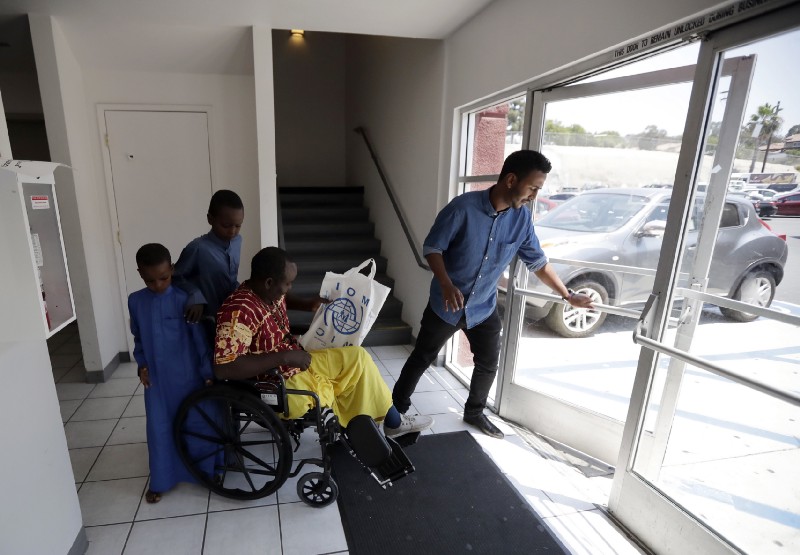
The U.S. Supreme Court will allow President Donald Trump to enforce part of his Muslim ban that blocks refugee resettlement.
On Wednesday, the Court stayed part of a lower court order that broadly exempted from the ban refugees who are in the process of being resettled.
The Supreme Court’s move means the stay will remain in effect until the case regarding Trump’s ban is resolved in the U.S. Court of Appeals for the Ninth Circuit — essentially, allowing the Trump administration to enforce this part of its ban as the case winds its way through the court system.
BREAKING: #SCOTUS denies DOJ request to clarify June 26 #travelban order, but stays dist ct order on refugees pending DOJ appeal to 9th Cir. pic.twitter.com/2mGMxjXfjM
— Chris Geidner (@chrisgeidner) July 19, 2017
There are about 24,000 refugees waiting to be resettled who don’t have a family member in the United States, but who do have a relationship with a refugee resettlement agency working to place them.
It’s not all good news for the Trump administration. The Court also declined the government’s request to clarify a previous ruling that held other people subject to Trump’s ban — nationals of Iran, Somalia, Sudan, Libya, Yemen, and Syria — may still enter the United States if they “have a credible claim of a bona fide relationship with a person or entity in the United States.”
The denial of this request means the lower court’s interpretation of this language, which is more permissive than the Trump administration’s, will be allowed to stand for now.
The Trump administration had chosen to interpret the Supreme Court’s previous order as narrowly as possible, saying that having a grandparent, grandchild, aunt, uncle, niece, nephew, cousin, or sibling-in-law in the U.S. doesn’t count as having a “bona fide relationship” in the country.
In a Hawaii district court order handed down last week, however, Judge Derrick Watson said the definition of a “bona fide relationship” needed to be broad enough to encompass those familial relationships.

In what represented a major blow to the ban, Watson also held that refugees who “have a formal assurance from an agency within the United States that the agency will provide, or ensure the provision of, reception and placement services to that refugee” are exempt from the ban, a broad ruling that essentially meant refugee resettlement could continue as usual.
The Supreme Court’s move on Wednesday keeps in place Watson’s definition of “bona fide relationship” for nationals of the six targeted countries, but reverses his ruling on refugee resettlement.
Three of the Court’s most conservative justices — Clarence Thomas, Samuel Alito, and Neil Gorsuch — dissented, saying they would have preferred to reverse Watson’s entire ruling and keep blocking grandparents, grandchildren, aunts, uncles, nieces, nephews, cousins, and siblings-in-law of U.S. citizens from entering the country.
On Monday, the State Department announced it would uphold Watson’s expanded definition of a “close familial relationship” for nationals of the six targeted countries, preempting the Supreme Court’s ruling on Wednesday.
The number of refugee admissions in 2017 reached 50,000 last week, the limit that Trump placed in his executive order. The number is significantly lower than the 110,000 limit that the Obama administration set last year.