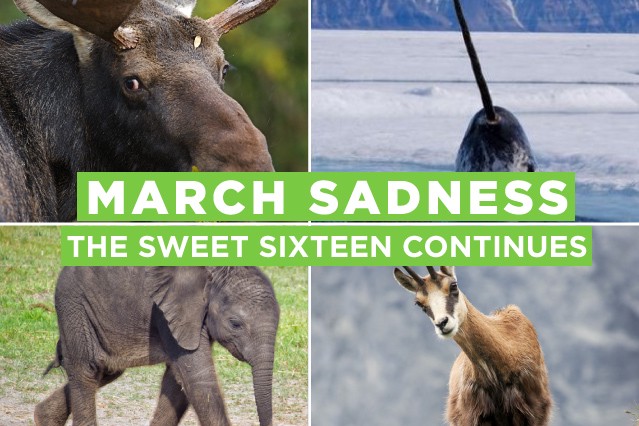
We’re halfway through the Sweet Sixteen in March Sadness, our bracket tournament of animals impacted by climate change and other environmental threats. You likely know this by now, but for whichever animal wins, ClimateProgress will write a feature-length article exploring the story behind what’s ailing your chosen critter, and who is working to save them. Read the rules here.
Last round was a toughie. Both our winners won by less than four votes. Seahorse pulled ahead of Whale in a last-minute victory, while Sea Otter was able to maintain its one-vote lead against Penguin.
Today, winners of our Hooves and Horns category will go head-to-head in a battle for your curiosity. We’ll tell you more about what’s threatening Elephants, Mountain Goats, Moose, and Narwhals — but only your votes can decide who moves on for a chance at a feature story. Vote in the embedded tweets below, on Twitter with the hashtag #CPMarchSadness, or on our Facebook page.
Elephant vs. Mountain Goat

Elephant: The tragic decline of both Asian and African elephants has been well-documented over the years. In Africa, demand for ivory and changes in land-use pose a serious threat to the species, according to the World Wildlife Fund. Asian elephants face similar threats from a growing human population, which is slowly taking away the animal’s forest habitat.
For this already-vulnerable animal, climate change is the nail in the proverbial coffin. Asian elephants are in grave danger of dying of heat stroke in Myanmar if temperatures raise even a few degrees higher than average, according to a 2013 study. Both Asian and African elephants are also threatened by water shortages brought on by drought, and hot, dry weather is particularly risky for elephants, since they rely on splashing water on themselves to help regulate their temperature.
Mountain Goat: Alpine chamois mountain goats are shrinking, and it’s because of climate change. They’re not just shrinking a little, either — they’re shrinking a lot. Specifically, the animals weigh, on average, about 25 percent less than they did 30 years ago, according to a 2014 paper published in the journal Frontiers in Zoology.
How is this climate change, exactly? Well, as average temperatures have risen 5° to 7° Fahrenheit in the goats’ Italian Alps habitat, scientists speculate that the goats spend more time resting in an attempt to avoid overheating — therefore, they’re eating less food. As of now, though, it’s unclear how the shrinkage will affect the goats. It could help them better withstand hotter summers, but it may may also mean the goats aren’t as prepared for harsh Alpine winters.
Which horned mammal will go to the next round?
Who is moving on? RETWEET for Elephant or FAVE for Mountain Goat #CPMarchSadness http://t.co/5j9mc8K14W pic.twitter.com/RplyDhxCYK
— Climate Progress (@climateprogress) March 30, 2015
Moose vs. Narwhal

Moose: Last round, we discussed how warmer, shorter northern winters pose concerns for moose in the form of more and more fleas and ticks surviving into the spring. This means that more moose suffer fates like some of those in Alaska and New England, who get weighed down by up to 100,000 blood-sucking ticks. Moose also require cool climates to thrive, overheating easily.
But it’s not just ticks and overheating that threaten moose. The U.S. Geological survey noted that because warming temperatures can increase the risk of infectious disease and parasite survival, they threaten potential hosts. Warmer temperatures increase the survival chances of the brain worm of the white-tailed deer, which can cause fatal neurological disease in moose should they eat the worm larva which overwinters in snails.
Narwhal: We noted last time that some scientists fear that narwhals face a singular threat from climate change because their diets and habitats could be reduced as Arctic oceans warm. Warmer waters could bring in not only more commercial fishermen to compete for food, but more killer whales, which hunt narwhals.
But it’s also shifting sea ice in a rapidly changing Arctic that threatens narwhals. Narwhals depend on cracks in the sea ice — called “leads” — to breathe between dives. These mammals are creatures of habit, so if winds, storms, or currents shift the usual locations of these leads, the narwhals risk drowning in crowded, small leads known as “entrapments.” Kristin Laidre is a marine mammal biologist at the University of Washington’s Polar Science Center who began noticing a change in when and where narwhals were facing these risks.
Who will make it to the next round for a chance at a feature story?
Who's your favorite? RETWEET for Moose or FAVE for Narwhal #CPMarchSadness http://t.co/5j9mc8K14W pic.twitter.com/EYGWdgO3Xn
— Climate Progress (@climateprogress) March 30, 2015
TOURNAMENT UPDATES:Day 1–3/19: Paws and Claws pt. 1 — Polar Bear vs. Wombat; Tasmanian Devil vs. Pangolin; (voting closed) WINNERS: Polar Bear and Pangolin.Day 2–3/20: Paws and Claws pt. 2 — Lemur vs. Koala; Panda vs. Wolverine (voting closed) WINNERS: Koala and Wolverine.Day 3–3/23: Fins and Flippers — Sea Lion vs. Sea Horse; Penguin vs. Manatee; Walrus vs. Sea Otter; Whale vs. Salmon (voting closed) WINNERS: Sea Horse, Sea Otter, Whale, and Penguin.Day 4–3/24: Horns and Hooves — Elephant vs. Horned Lizard; Rhino vs. Narwhal; Saola vs. Moose; Mountain Goat vs. Reindeer (voting closed) WINNERS: Elephant, Narwhal, Moose, and Mountain Goat.Day 5–3/25: Shells and Wings — Sea Turtle vs. Pelican; Sage Grouse vs. Peregrine Falcon; Oyster vs. Butterfly; Lobster vs. Red Knot (voting closed) WINNERS: Sea Turtle, Falcon, Butterfly, Red Knot.Day 6–3/26: Polar Bear vs. Pangolin; Koala vs. Wolverine (voting closed) WINNERS: Polar Bear, Wolverine.Day 7–3/27: Sea Horse vs. Whale; Sea Otter vs. Penguin (voting closed) WINNERS: Sea Horse, Sea Otter.Day 8–3/30: Elephant vs. Mountain Goat; Moose vs. Narwhal (voting closed) WINNERS: Elephant, Narwhal.Day 9–3/31: Sea Turtle vs. Red Knot; Butterfly vs. Peregrine Falcon (voting NOW OPEN)Day 10–4/1: TBDDay 11–4/2: TBDDay 12–4/3: THE FINAL FOUR: TBD Day 13–4/6: THE CHAMPIONSHIP: TBD
PAST ROUNDS:Round 7: Sweet Sixteen, part 2Round 6: Sweet Sixteen, part 1Round 5: Shells and WingsRound 4: Horns and HoovesRound 3: Fins and FlippersRound 2: Paws and Claws, part 2Round 1: Paws and Claws, part 1