A lawsuit filed this week in federal court takes aim at the way the military handles accusations of sexual assault and harassment — perhaps in hopes of making courts push through changes that have failed to pass in Congress.
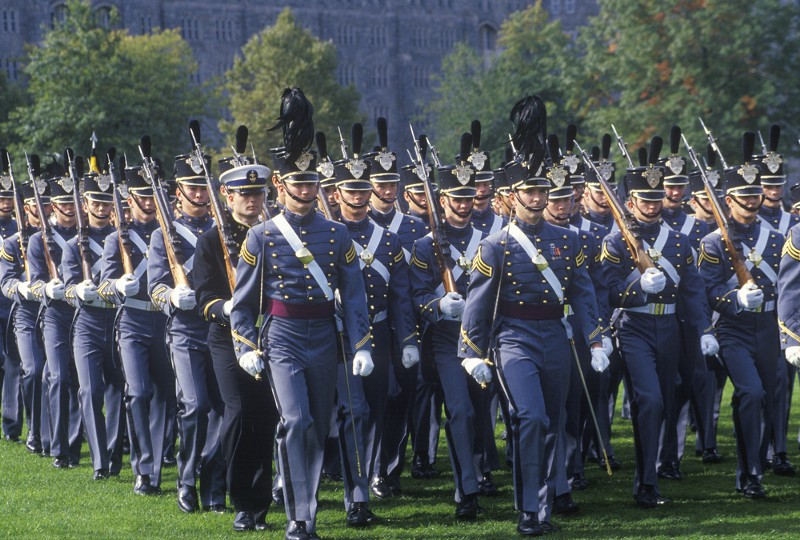
The lawsuit, brought by attorney Susan Burke on behalf of three former servicewomen and one active duty servicewoman, alleges that the Department of Defense has poorly handled their cases, putting military commanders — who sometimes participate in misconduct — in charge of investigating charges of sexual assault or harassment. One of the cases listed in the complaint discusses a high-profile scandal involving the West Point rugby team, in which then-Cadet Baldwin alleges unwanted sexual touching from male cadets. Baldwin, now a first lieutenant deployed in Kuwait, also complained of a culture of harassment at West Point.
She alleges military officers at West Point “disseminated and sang” a violent song called “S&M; Man,” which included graphic lyrics. Some of those lyrics, according to the complaint, included the words: “Who can take two ice picks, Stick ’em in her ears/Ride her like a Harley While you Fuck her in the rear…/Who can take a machete, Whack off all her limbs/Throw her in the ocean, and try to watch her swim.”
The new complaint follows a March 27 story in the Army Times that revealed the details of a heavily redacted report from the Department of Defense on the West Point scandals. The complaint alleges that the DoD’s report “whitewashes and covers up extensive sexual harassment at the United States Military Academy / West Point.”
The report included redacted versions of some emails from the West Point rugby team, including some that detailed sexual exploits in graphic detail. Excerpts included in the DOD report, as detailed by the Army Times, included language like, “P.S. [redacted] got his s — t ROCKED tonight. Learn from it, b — — es. Although I can’t say I support it …” and “[Redacted] girl was so big she broke the bed. Check for yourself when you get to the house.” Some of the emails included Facebook photos or mentions of female cadets and recipients were warned to keep the emails private. The report pointed out that several of the cadets involved had already graduated and merely recommended “reviewing the chain of command.” The West Point rugby team was disbanded for six months and returned to competition on Jan. 14, and two second lieutenants are still under investigation.
The four women who serve as plaintiffs on the case — Jennifer Smith, Alyssa Rodriguez, Carmelita Swain, and Celina M. Baldwin — each outline ways in which the military justice system failed them. Baldwin experienced being “touched without her consent” and “was raped by a West Point colleague during a period of time when she lacked any capacity to consent to intercourse.” Rodriguez reported her rape, but “the convening authority, General Franklin, refused to refer the case for trial.” (Franklin was later removed from the Air Force over his handling of sexual assault cases.) And while deployed in Afghanistan, “a noncommissioned officer raped [Swain] in her barracks,” but when she reported it, “her rapist was set free with no consequences to his military career.”
The complaint from Smith is particularly graphic:
When she arrived in Germany, her Master Sergeant met her, took her out, and required her to participate in a drinking game called “coining.” He bought her 10 shots of alcohol, and observed as she became completely intoxicated. Smith, knowing she was intoxicated in a foreign land, asked the Master Sergeant to bring her back to her living quarters. When they arrived at the barracks, Smith thanked him for walking her back, and said goodnight. He responded, “you’re not going anywhere, bitch.” He then pushed into the room, dropped his pants, and told her to “come over here and touch it, cunt.” At that point, as TSgt Smith verbally and physically resisted the sexual assault, several other Airmen were able to get into the room and took TSgt Smith physically away from the attacking Master Sergeant.
When Smith reported on other incidents that she believed were interfering with her ability to serve, “Nothing was done.”
“According to the Department’s own data, in the most recent year reported for convictions, the military justice system managed to court-martial, convict and incarcerate only 276 perpetrators. Yet the Department itself estimates more than 26,000 rapes occurred that year,” the lawsuit said.
“This military judicial process is broken, because the Department repeatedly fails to terminate sexual harassers from the military, and instead lets those biased and hostile persons control military judicial proceedings. As a direct result of the Department’s failure to operate an impartial system and instead place power in untrained and biased hands, Plaintiffs Baldwin, Rodriguez and Swain are among the thousands of service member survivors who have to endure seeing their rapists go unpunished in any way,” the complaint said.
At issue is the structure of sexual assault and harassment reporting in the U.S. military. All branches require victims to report incidents to their commander, but many argue this is problematic, because military commanders are often not in a good position to investigate perpetrators of sexual assault or harassment — and may even be the perpetrators themselves. The lawsuit seeks to block military commanders from reviewing cases.
A proposal by Sen. Kirsten Gillibrand (D-NY), which achieved bipartisan support in the last Congress, would seek to take reporting of such incidents outside of the chain of command, and have them handled by an independent body. The proposal was met with objections from the Department of Defense and military commanders, saying that changing reporting requirements would undermine the authority of commanders’ ability to achieve discipline in the ranks. These arguments gained some traction with Sen. Claire McCaskill (D-MO), who sponsored a different proposal to keep reporting within the chain of command. They partnered together on another proposal to combat sexual assault on college campuses.
Gillibrand is on West Point’s “Board of Visitors,” which met on Monday to discuss the scandals. Lt. Gen. Robert Caslen Jr., who has served as West Point’s superintendent since July, said his goal is to “change the culture.”
But many who work on this issue are skeptical that changes are coming. Protect Our Defenders, which advocates for victims of sexual assault, urges the DoD to take action. “The ongoing, but fixable sexual assault crisis is costing our military its best and brightest, not to mention hundreds of millions of dollars in VA costs every year. Unfortunately, the Pentagon continues to place commanders into an impossible position, in many cases they must choose who they believe between a victim and what appears to be a good solider, who may also be a sexual predator,” Col. Don Christensen, the former Chief Prosecutor of the Air Force and President of Protect Our Defenders said in a statement to ThinkProgress.
“The majority of victims remain in the shadows, while criminals terrorize more brave men and women in uniform and then these rapists are released into our communities without appropriate tracking,” Christensen said.