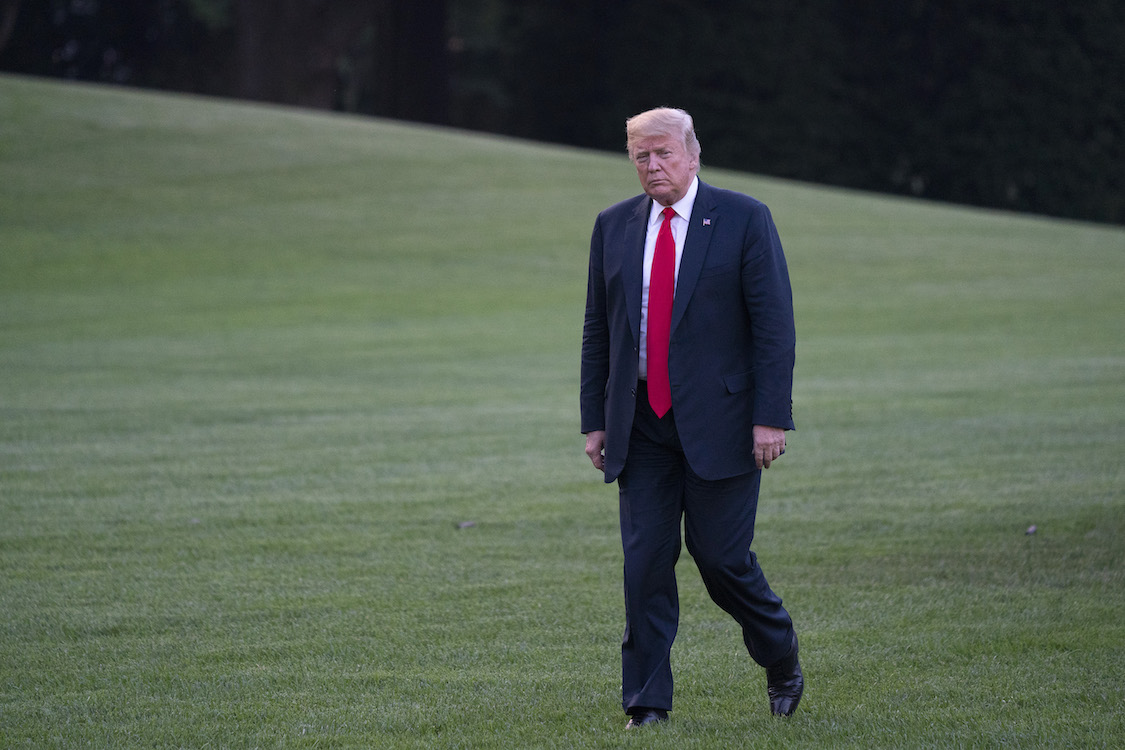
In the second quarter, the U.S. gross domestic product (GDP) increased at an annual rate of 4.1 percent, making it the strongest quarter since 2014. Trump celebrated this number on Friday and promised that it would continue to increase, despite economists and policy experts’ caution not to read too much into this single quarter.
“The United States economy grew at the amazing rate of 4.1 percent,” President Donald Trump said during a press conference on Friday morning. “We’re on track to reach the highest annual growth rate in over 13 years. I will say this and I will say it strongly. As the trade deals come in, one by one, we’re going to go a lot higher than these numbers, and these are great numbers.”
Vice President Mike Pence tweeted, “PROMISES MADE AND PROMISES KEPT!” and Donald Trump, Jr. called the GDP increase “incredible.”
In 2016, @POTUS Trump stated his “goal of reaching 4% economic growth.” Today’s GDP report shows our economy growing at 4.1%. PROMISES MADE AND PROMISES KEPT!https://t.co/BH96OG3Mfg
— Vice President Mike Pence (@VP) July 27, 2018
But this growth is more of a blip than a long-term trend, economists said on Friday. According to The New York Times, most economists expect this growth to wane in the second half of this year. In the first quarter, the GDP rose at a rate of 2.2 percent.
Josh Bivens, director of research at the Economic Policy Institute, said there is “little in these six months of data to indicate that American economic growth has moved off the same trend that has characterized most of the post-Great Recession recovery.”
“GDP growth doesn’t tell us much about the real economy,” Nell Abernathy, vice president for policy and research at the Roosevelt Institute, a think tank that focuses on issues of inequality, said in a statement in to ThinkProgress. “There is not much to celebrate unless that growth is translating into higher wages for average Americans or more investment in the activities that grow our economy for the long term.”
Many economists have pointed to exports of soybeans as an example of how trade tensions have affected the GDP. Soybean exports increased more than 50 percent in May from the year before. This likely happened because farmers wanted to make sure they made shipments before July. China targeted U.S. soybeans, and other U.S. products imposed tariffs on about $50 billion in Chinese goods.
A soybean farmer in Iowa, Ron Heck, told CBS News, “We’re all upset. We’re all losing money. We’re raising a great crop and our biggest customer comes along and says we don’t want to buy it.”
Trump’s tariffs have also led to retaliation from other trade partners, such as Mexico, Canada, and the European Union.
Ellen Zentner, chief United States economist for Morgan Stanley, told the New York Times, “We’re getting explosive growth in the second quarter because of trade. You’ve got a big hole on the other side of that.”
Jay C. Shambaugh, senior fellow in economic studies at the Brookings Institution, tweeted that there has been “a small but meaningful pickup in growth so far in 2018,” but growth over the last year, “while good, is not that high.”
There’s been a small but meaningful pickup in growth so far in 2018. But the quarterly reading is not a shock (quarterly GDP is volatile, was higher many times in last 8 years) and even the growth over the last year, while good, is not that high (higher in 2015:Q2)
— Jay C. Shambaugh (@JayCShambaugh) July 27, 2018
Ernie Tedeschi, a former senior advisor and economist at the U.S. Treasury, said the acceleration had to do with a rush to export inventories before the tariffs took effect rather than increase production.
In other words, one story that fits the data is that firms didn't ramp up new production in anticipation of the tariffs, they just rushed to export their existing inventories. Doing this has a net impact on GDP of zero from an accounting standpoint.
— Ernie Tedeschi (@ernietedeschi) July 27, 2018
This isn’t the first time Trump and his supporters have celebrated economic data without acknowledging the full economic picture for many Americans. In February, Trump bragged about wage increases and said, “Everyone said, ‘You’ll never do it’ — after years of wage stagnation, wages — so what happened two days ago and a month ago — wages are now, for the first time in many years, rising.”
According to the Washington Post, the president falsely suggested wages were on their way up directly because of his policies eight times during his first year in office. But despite Trump’s glee in February over the monthly jobs report, in which average hourly earnings rose 0.3 percent from a month earlier and 2.9 percent from a year earlier, the long-term wage trends have not been encouraging. Wages simply haven’t moved as much as economists would expect for an economy with low unemployment. U.S. wages were only 10 percent higher in 2017 than in 1973, according to the Hamilton Project.