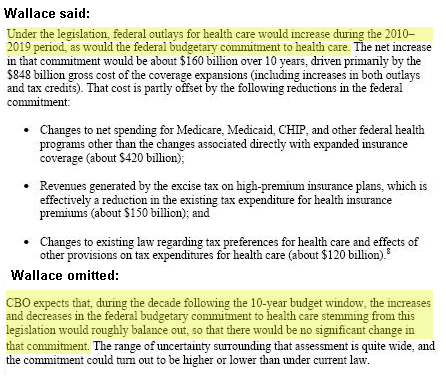
This morning on Fox News Sunday, host Chris Wallace selectively quoted the Congressional Budget Office analysis of the merged Senate legislation to suggest that the Senate health legislation would increase government outlays on health care over 20 years and bend the cost-cure upward:
WALLACE: According to the nonpartisan Congressional Budget Office, federal outlays for health care would increase during the 2010–2019 period and the government run health insurance plan would typically have premiums that were somewhat higher than the average premiums for the private plan. So here’s the question. The Democratic plan by the CBO’s own scoring fails to bend the famous health care cost curve at all over the course of these 10 years, and could you name a single Congress that has ever cut Medicare by half a trillion dollars as this legislation would?
Watch it:
As Sen. Arlen Specter (D-PA) pointed out, the $848 billion bill “would save $130 billion in the first 10 years and projected to have $650 billion saved in the second 10 years.” Page 16 of the CBO report does predict that “federal outlays for health care would increase during the 2010–2019 period,” but the last paragraph of that same page also notes that “during the decade following the 10-year budget window, the increases and decreases in the federal budgetary commitment to health care stemming for this legislation would roughly balance out, so that there would be no significant change in the commitment.”
As a result, the federal government would be spending less on health care in the decades following the initial 10-year window, despite the expansion in coverage:
Wallace’s claim that the bill “fails to bend the famous health care cost curve” is also inaccurate. The legislation establishes an Independent Medicare Advisory Board (IMAB)– which is required to “recommend changes to the Medicare program to limit the rate of growth in that program’s spending” — and places a 40% excise tax on insurers that offer expensive policies. While the budget office did not analyze the effect of the legislation on national health expenditures, the CBO is predicting that spending per Medicare beneficiary would decrease, as compared to the growth rate of the past two decades (from 8% growth rate to 6% growth rate).
As for the public option, the CBO did conclude that the plan could attract sicker enrolles and charge slightly higher premiums, but it would still reduce average premiums “and hence federal subsidies for premiums.” “That’s because average premiums would be even higher if the people enrolled in the public plan enrolled in private plans.” In fact, the CBO has concluded that the Senate’s public option would save the government $3 billion over 10 years.
Finally, Congress did pass a series of Medicare cuts as part of the Balanced Budget Act of 1997 that were actually deeper than anything being considered today. That act decreased Medicare spending by 12.7% over 10 years and instituted the kind of payment updates that the Senate bill is now recommending. The Senate health care bill would cut Medicare by some 5–6% over 10 years. Specter voted for that bill, with many of his then Republican colleagues.