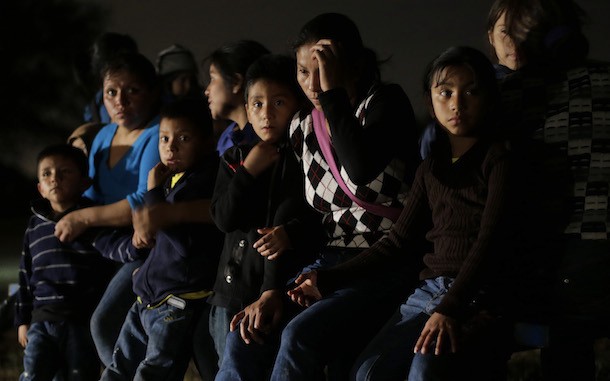
About 438 children who crossed the southern U.S. border alone, fleeing poverty and gang violence from Latin America were placed with sponsors in Minnesota in the 2014 and 2015 fiscal years. At least 59 of those children have already been given deportation orders, “usually after skipping their court hearings,” the Star Tribune recently reported. And an undetermined number of additional kids are facing fundamental barriers to making their legal case that are exacerbated in the small rural towns where many migrants live: a lack of transportation to the Bloomington immigration court located three hours away in Minneapolis, a critical shortage of legal representatives, and few court interpreters who speak the appropriate language.
Immigration courts were overloaded last summer as President Obama called on immigration judges to expedite the cases of more than 68,000 Latin American children, most from El Salvador, Guatemala, and Honduras. The so-called “rocket docket” focused on fast adjudication, a process that advocates criticized as they scrambled to find legal representation for the children nationwide.
Few transportation options
In the meatpacking towns of Marshall and Worthington where many of the kids reunited with their families, there are limited transportation options to make it to court. Only one bus leaves from Marshall to Minneapolis every afternoon. Parents of unaccompanied children must then find overnight accommodations in Minneapolis. Parents must also take time off work, time that employers often do not grant to undocumented workers.
As a result, children have to rely on other means of transportation since state law prohibits undocumented immigrants from obtaining driver’s licenses. Only those shielded from deportation through the president’s executive action known as the Deferred Action for Childhood Arrivals (DACA) program have access to licenses.
“There are some people who charge $500 for a ride to Minneapolis,” Bob Quasius, president of the immigration reform advocacy group Cafe Con Leche Republicans told ThinkProgress. Since last summer, he has driven several children to immigration court. He also helps to translate Spanish. He charges anywhere between $10 and $25 to help cover the cost of gas from Marshall.
But because children rarely get their cases resolved in one court hearing, Quasius said that’s where he sees a drop off in the number of children attending their court hearings. “It’s beyond the means of many families to pay for transportation each way,” he said. “There’s a lack of resources to prepare and coach kids for court. There’s also a language barrier.”
In Quasius’ experience, parents almost never come along for the journey to immigration court. Misinformation about the deportation process has rendered parents feeling reluctant to enter the federal building that houses the immigration court. Quasius observed, “It’s very difficult to communicate with [the parents] that there’s space in the car so they can easily go. They lack government-issued identification, even though many have Guatemalan IDs. So far, only one parent has gone with me. The immigration court wants a parent or a legal representative, but usually for the first hearing, I’m the one who goes with the child.”
The one parent that made the trip was an immigrant with legal status, Quasius noted. He also stated that one mother “wasn’t able to take the day off work. She would’ve lost her job.”
Kim Hunter, an immigration lawyer based in St. Paul, has noticed that fear in other undocumented parents. She told ThinkProgress, “The adults are often too afraid to come inside the immigration court room. If I encourage them, then they’ll come into the building. But they won’t enter the courtroom with their children.”
“Any encounter with law enforcement could result in deportation.”
“Any encounter with law enforcement could result in deportation,” Hunter said, explaining the rationale that undocumented immigrants have told her. “Up until the president issued prosecutorial discretion, people really were at risk for deportation. There has been a historically high number of deportations under the Obama administration, so with the people driving without licenses, if they got caught up in the immigration system, they would be pushed into deportation.”
In 2011, the Obama administration began issuing a series of memos asking immigration agents to prioritize the detention of undocumented immigrants who have committed serious offenses. But immigration officials have the ability to exercise prosecutorial discretion and make individual calls about whether or not to pursue deportation. Activists argue that the discretion has been subjective and incomplete. Many undocumented immigrants with old crimes or minor offenses were also still caught in the deportation dragnet. As of last year, deportation watchers believe that the Obama administration had carried out two million deportations.
Problems inside the courtroom
Once inside the courtroom, children are plagued by two main issues: a language barrier and a lack of legal representation. According to Quasius, the Bloomington immigration court only has one Kiche’ language interpreter who comes once a month. Even so, many of the unaccompanied children from Marshall and Worthington only have a basic understanding of Spanish since they primarily speak Kiche’ or Mam, two Guatemalan dialects.
“Some speak Spanish,” Quasius said. “You can carry on a basic conversation to get them to the courtroom, but to have a detailed conversation about a complex legal situation, they don’t understand asylum and can’t understand you to begin with.”
Both the United Nations High Commissioner for Refugees (UNHCR) agency and the Vera Institute previously found that children fleeing Central american are eligible for some sort of legal relief (like asylum) or left their countries because they had international protection needs.
The judge wanted to go forward anyway with a Spanish interpreter.
“One time, [a] child who went through six hearings showed up, but the court didn’t have an Kiche’ interpreter,” Quasius said. “The judge wanted to go forward anyway with a Spanish interpreter. But [the child] only has limited knowledge. Legal Aid came to help, but the organization said that it’s difficult finding a Kiche’ interpreter. He only shows up one day a month.”
John Keller, the executive director at the Immigrant Law Center Of Minnesota, told ThinkProgress that a type of “three-way interpretation” situation arises with children who only speak in Guatemalan dialects.
“Basically the translation begins with the client to the court interpreter, then to the judge,” Keller said. “There’s Mam to Spanish, Spanish to English. The standard by which interpreters are supposed to accurate is 70 or 80 percent. You can see how that’s problematic when this is twice removed.”
Keller explained, “In terms of a major challenge, we are seeing an unrelenting pace in the deportation process for these kids. As a legal service organization, we’re already operating at capacity. The rocket docket Obama’s prioritization of these cases force many people to go forward without assistance from counsel. Only 2–4 week continuances to find an attorney in Minnesota isn’t enough time for these complex matters. When you have kids who have gone through trauma, the best practice is for kids to find someone they can trust, and that takes time.”
The Immigrant Law Center has taken on about 25 to 30 unaccompanied cases in the last two years and would take more if funding were available.
“I only have half a dozen cases because I don’t speak Spanish,” Hunter said. “There are challenges for a lot of kids who are eligible for Special Immigrant Juvenile Status (SIJS). You need a family court order first and very few immigration lawyers here practice in any forum other than in immigration court. Even if you can take on a child in immigration court pro bono, good luck trying to find someone in family law pro bono. Especially in rural Minnesota, it’s possible to not find family law practitioners who are not swamped from other cases as well.”
Funds are running low for the Immigrant Law Center. Keller noted that his organization had just raised about $20,000 from a recent fundraiser. Currently his organization is “using general operation funds to continue. There’s no money left in our budget to take on these cases. The life cycle on these cases is much much longer than you’d think. Even though we’re talking about expedited deportation proceedings, when you lay out the staff time to take on one case, there’s just so much intense work on an asylum case or to pursue SIJS.”
“This is easily one of the most time-intensive cases that we take on.”
Update:
The previous post misquoted John Keller and has been updated.